Автор: The Findmykids Editorial Team

  • Should You Help With Homework — or Step Back?

    Время на прочтение: 3 минут(ы)

    Sometimes we do homework together with our kids. For some, it happens because the child struggles and asks for help. Other parents worry about grades and try to make sure everything goes smoothly. And sometimes, the urge to control schoolwork comes from the parents’ own anxiety.

    These situations are familiar to many families. But it’s important to ask: does this kind of help really build a child’s independence, confidence, and ability to handle challenges?

    What Research Shows

    According to various studies, parental involvement in a child’s school life is generally beneficial: children feel more confident, less anxious, and better able to adapt to academic demands. However, when it comes to homework help, the results are mixed.

    A meta-analysis shows that children who often receive help with homework tend to perform worse academically. But it all depends on the type of help. When parents support curiosity and ask guiding questions, such help is useful. Conversely, doing the assignments for the child or being overly controlling can harm both learning and the parent—child relationship.

    A meta-analysis is a research method that combines data from multiple independent studies on one topic to draw more reliable conclusions.

    Other studies emphasize that the style of help plays a key role. Supporting independence and respecting effort have a positive effect on motivation and confidence. Constant monitoring and overprotection, on the other hand, undermine initiative and prevent responsibility from developing.

    Research also shows:

    • The effect of parental help depends on the child’s age, family environment, and cultural background. Younger students benefit from clear structure — when adults help them organize their time and explain how to complete tasks. For older children, trust and independence matter more.
    • When parents respect their child’s efforts and believe in their abilities, it lowers anxiety and boosts confidence. But when help comes with frustration or parental anxiety, it has the opposite effect — the child becomes afraid of making mistakes and loses interest in learning.
    • Reviews show that when a child starts struggling at school, parents often respond with tighter control, but that only reduces motivation and performance, creating a vicious cycle.

    Why Doing Homework Together Can Be Harmful

    Doing homework side by side is not always helpful. Parents may truly want to support their child, but in practice, it can lead to unintended consequences:

    • The parent becomes a “second teacher,” and the child finds it harder to act independently.
    • Homework turns into a source of conflict instead of growth.
    • When parents complete tasks for the child, they stop practicing skills and lose ownership of learning.
    • The child begins to study to meet parental expectations, not for their own curiosity or goals.
    • Anxiety increases, especially if every step is criticized or checked.

    How to Help With Homework the Right Way

    Homework help can be valuable if it supports independence and creates a calm atmosphere. The goal is not to solve tasks for your child, but to help them find their own way.

    • Show interest in the process. Ask what your child will start with and how they plan to solve the task. This shows respect for their effort and helps them think more independently.
    • Encourage independence. Guide them toward answers, but don’t give them right away. Mistakes are part of learning, and fixing them on their own builds confidence.
    • Ask questions instead of giving answers. Use open questions to help your child find the solution themselves. This develops reasoning and analytical thinking.
    • Create emotional support. Help your child focus calmly. Praise not only correct answers but also effort, patience, and perseverance.
    • Help with organization. Set up a comfortable workspace, teach time management, and remind them to take breaks. This lowers stress and builds planning skills.

    Doing homework with your child isn’t always necessary. Parental involvement truly matters, but what counts most is how you help, not how much time you spend together.

    Support, trust, and genuine interest do far more good than control and pressure.

    References

  • The New Kid: Helping Your Child Fit In

    Время на прочтение: 2 минут(ы)

    A child’s mood and school performance depend a lot on how comfortable they feel among classmates. When kids have friends and feel connected, school becomes a place they want to go, not just somewhere they have to be. Let’s see how you can help your child adjust to a new class and build friendships.

    The First School Year: Helping Your Child Connect

    For first graders, school is a brand-new world — lessons, rules, teachers, and classmates. Parents can help a child develop a warm attitude toward school.

    Share your own memories

    Tell your child what you loved about school — a kind teacher, fun lessons, loyal friends. Emphasize that school is the first step into the world of knowledge, full of opportunities and discoveries.

    Show the power of kindness

    Simple words like “hello,” “please,” and “thank you,” as well as listening and expressing opinions respectfully, help children earn goodwill. The best way to teach this is by showing it in your own behavior at home.

    Practice starting a conversation

    Explain that friendships often begin with the first step. Come up with a few easy openers together — “How was your weekend?” or “What’s your favorite cartoon?” Showing interest in others makes them more likely to respond warmly.

    Ask and listen

    After school, find a moment to ask about your child’s day — what went well, who they talked to, what they learned. Even if something didn’t go as planned, your attention and faith in them give confidence and comfort.

    Encourage playdates and time together

    Invite classmates over or suggest going to the park or playground together. Shared experiences help children bond faster and feel like part of the group.

    Joining a Class That’s Already Close

    If your child joins a group that’s been together for a while, it might take a little more time to adjust. Before school starts, try to learn about classroom routines, dress codes, or traditions. Talking to the teacher in advance can also help prepare your child.

    • Think about their first impression. A cool pencil case, a fun backpack pin, or a unique notebook can spark a conversation, as long as it feels natural and reflects your child’s personality. But flashy gadgets or expensive clothes can sometimes create distance rather than connection.
    • Talk through conversation topics. Encourage your child to think about what they might share about themselves — a hobby, a fun fact, a favorite book. The key is to be natural, not rehearsed. Sincerity always helps build trust.
    • Give it time. Other kids also need time to get to know the newcomer. Sometimes, strong skills or confidence can seem intimidating at first, so it’s better to let abilities shine gradually, through genuine situations.

    Helping Older Kids Adjust to a New Group

    In middle or high school, relationships with classmates become especially important, and parents can still help.

    • Separate your experience from theirs. Even if your school days were very different, your child’s story is their own. Your experience matters, but try not to project your worries or expectations onto them.
    • Notice changes. If your teen becomes quieter, loses interest in usual activities, or spends most of their time gaming, it may be a sign that fitting in isn’t easy. Early attention to these shifts can make a big difference.
    • Ask in a way that’s easy to answer. Instead of “How’s school?”, try “I’ve noticed you haven’t talked much about your new class lately. Want to tell me what’s been going on?” This shows you care, without pressure.

    Moving to a new class or school is always a challenge. It’s natural for a child to feel uncertain at first. What matters most is that they know all their feelings are valid, you understand, and you’re there for them. And we’re here to help you with care and advice along the way.

    References

  • When Your Teen Lives Online: Understand Them

    Время на прочтение: 2 минут(ы)

    Many parents worry when their son or daughter spends long hours playing computer or console games. But this isn’t always a sign of a problem.

    Research shows that games can help develop imagination, focus, and problem-solving skills. This is especially true for teens who create their own worlds, come up with strategies, and connect with other players.

    For an introverted child who struggles to make friends offline, gaming can be a place where they feel confident, seen, and understood. Let’s look at how to tell the difference between a healthy hobby and a situation where gaming starts to take over real life.

    When Gaming Becomes a Red Flag

    A systematic review of studies found that spending too much time online can increase anxiety and reduce sleep quality. If your teen rarely leaves their room, stops hanging out with friends, or changes their sleep schedule, it’s time to gently step in.

    Other warning signs include a drop in grades, poor sleep or eating habits, loss of interest in old hobbies, or aggression when you try to interrupt the game. It’s important to look at your teen’s overall emotional state, not just the number of hours spent gaming.

    And remember: for many introverts, online communication is their main form of socializing. Cutting off games completely can trigger resistance and deepen isolation.

    What Helps — and What Doesn’t

    Research also shows that long periods of isolation can make it harder for teens to recognize and manage emotions — both their own and others’. Those who spend all their time online may struggle more in face-to-face communication.

    In 2025, researchers found that when parents genuinely take interest in what they play and do online, it builds trust and reduces the risk of gaming addiction.

    How to Talk With a Teen Gamer

    Teens often see gaming as a part of life, not just entertainment. If you start the conversation with criticism or bans, it’ll end quickly. It’s better to show real curiosity about your child’s virtual world.

    • Start with interest, not judgment. Ask your teen to show you their favorite game and explain how it works.
    • To keep the conversation easy and natural, use open-ended questions: “What do you like most about this game?”, “How do you choose who to play with?”, “Which win was the most memorable for you?”
    • Find balance together. Set clear times for gaming and for other activities.
    • Notice the positives in gaming. If a game involves creativity or teamwork, highlight those strengths. For example: “I like how you come up with strategies with your friends. It’s like a small team project.”
    • Encourage offline interests related to gaming. Suggest drawing game characters or creating a real-life version of something from the game.
    • Try playing together. Even a short co-op session can become a great bonding moment, and help you understand what your teen enjoys in the game world. (Just maybe don’t start with It Takes Two — we tried. It’s so fun you might not want to stop!)

    Real-Life Story

    “I never understood video games, not as a kid, not as an adult. I used to be skeptical about them. But one day, Ethan asked me to play with him, and surprisingly, I said yes.

    He showed me everything — explained the goal, told me which buttons to press. After a few tries, I started getting the hang of it. He was so proud!

    And I began to see why kids love games so much — these worlds, the stories, the adventures. It’s like reading a book and being the main character at the same time.”

    — Jessica, mom of 14-year-old Ethan

    Games can be both a resource and a risk. The key is to see the person behind the screen — a teen with their own fears, joys, and need to feel understood. Your curiosity and respect for their world can help you stay connected and keep a healthy balance.

    References

  • Parental Burnout: Signs and Solutions

    Время на прочтение: 3 минут(ы)

    Parenting brings both joy and responsibility. But constant stress and daily demands can lead to a state where you feel completely drained — that’s what parental burnout is. Let’s look at what it means and how you can recover.

    What Is Parental Burnout

    Experts define parental burnout as a chronic state of physical, emotional, and mental exhaustion caused by prolonged stress related to raising and caring for a child.

    Research shows that burnout develops gradually. At first, many parents think it’s just temporary tiredness, but without proper self-care, the condition can worsen over time.

    Causes of Parental Burnout

    Burnout rarely comes from one single cause. It’s usually the result of several factors combined. Some of the most common include:

    • Constant emotional and physical strain — daily responsibilities without real recovery time.
    • Lack of support — no one to step in or share the load, even for a short while.
    • Unrealistic expectations — trying to be the “perfect parent” and do everything flawlessly.
    • No personal time — complete absence of rest or space for yourself.
    • Social pressure — idealized images of family life in media and social networks that make parents feel like they’re falling short.

    Each of these can cause fatigue on its own, but together, they create the perfect storm for burnout.

    How to Recognize It

    It’s important to know how to distinguish burnout from ordinary tiredness. If you’ve been noticing several of these signs for a while, it’s time to pay attention to your well-being:

    • Constant fatigue that doesn’t go away after rest
    • Irritability and impatience toward your child
    • Feeling that daily tasks have become overwhelming
    • Loss of joy or emotional connection with your child
    • A sense that you’re no longer managing your parenting role
    • Doing parenting tasks mechanically, without emotion

    The sooner you recognize what’s happening, the sooner you can start recovering and prevent things from getting worse.

    What Burnout Leads To

    Ignoring early signs of burnout can affect every part of life — both yours and your child’s.

    For the Parent

    You may experience insomnia, chronic fatigue, headaches, and weakened immunity. Psychologically, burnout can cause irritability, anxiety, or even depression. Motivation fades, and life starts to feel dull.

    For the Child

    Children are highly sensitive to their parents’ emotions. When a parent is emotionally drained, the child may feel rejected or guilty.

    This can show up as changes in behavior, school performance, or confidence. Some children withdraw, while others become overly anxious or emotional.

    Studies show that in severe cases, burnout makes it harder for parents to stay emotionally connected to their children — weakening closeness, trust, and mutual understanding.

    A large review of data from different countries also found that burnout can increase the risk of emotional or physical aggression — a clear signal that both parents and professionals must take the issue seriously.

    How to Recover

    With the right approach and support, it’s absolutely possible to regain energy and joy. Recovery usually involves several steps:

    • Acknowledge the problem: Understand that it’s not your fault, and you’re not alone in this experience.
    • Seek support: Ask for help from loved ones, friends, or a therapist.
    • Make time for rest: Schedule short breaks, even if it feels like there’s no time.
    • Adjust expectations: Let go of perfectionism — being a “good enough” parent is more than enough.
    • Use restorative practices: Try breathing exercises, walks, or mindfulness techniques.
    • Do something you love every day, even for 10–15 minutes.
    • Build a support system: Connect with other parents, share experiences, and find understanding.

    Take small, manageable steps, but do them consistently. Even minor changes can gradually restore your inner balance.

    Parental burnout is your mind and body’s way of saying: it’s time to pause and take care of yourself. Caring for yourself isn’t selfish — it’s an essential part of caring for your child’s well-being, too.

    References

  • Rescue or Not? When Your Child Says “I’m Booored”

    Время на прочтение: 3 минут(ы)

    You’ve probably heard it before: the cartoon just ended, and suddenly you get a long, drawn-out: “I’m boooored.” Your child wanders around the house, doesn’t know what to do, and asks again for more screen time.

    Boredom isn’t just a pause between activities. It’s a space where your child has the chance to come up with something of their own.

    Let’s see why kids ages 7–12 often feel bored and how you can support them in this feeling.

    Why Kids Get Bored

    Boredom happens when the world around them has temporarily lost its novelty, and they don’t yet have enough ideas inside. Kids ages 7–12 are still developing the ability to manage their emotions and plan their actions. Feeling bored at this age is completely normal.

    Younger school-age kids don’t yet have enough life experience to quickly think of something to do. They get bored because they haven’t learned how to manage their attention, switch gears, or know what to do when no one is entertaining them.

    Why You Shouldn’t Ignore Boredom

    Boredom itself is a natural state. But if a child can cope only with gadgets or constant entertainment, it may get harder over time for them to find things to do on their own. That can hold them back from developing initiative, the ability to be alone with themselves, and the skill of finding activities without outside direction.

    When a child faces boredom but can’t find ways to manage it alone, it gets harder to handle emotions and stay interested. They might become more irritable or passive, drop projects halfway through, avoid being alone, or not even realize what they truly want. That’s why it’s important to help them experience boredom instead of running away from it.

    How to Help a Child Work Through Boredom

    1. Acknowledge the boredom
      It’s okay to be bored. Don’t dismiss it with: “Bored? That’s great!” Instead, say: “You’re bored. That happens.” This gives them grounding and eases anxiety.
    2. Don’t rush to fix it
      Give them a pause. Instead of ready-made ideas, ask: “What can you think of yourself?” This sparks thinking and initiative.
    3. Encourage creative activities
      Building with Legos, making crafts, drawing, writing stories or comics, experiments, games with rules — all of these help kids invent their own activities and feel confident in their ideas.
    4. Don’t rescue them every time
      Even if they wander around saying, “Nothing’s working,” give them time. Sometimes boredom is just the bridge between doing nothing and starting something, and they need to cross it themselves.
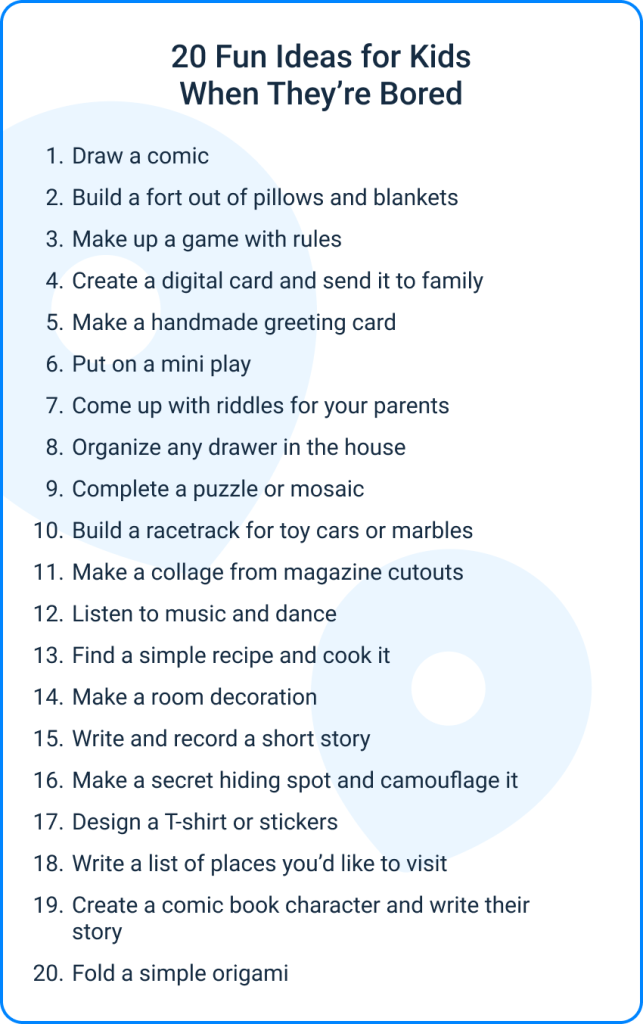
    5. Create a “boredom list” for your child
      Sit down together and write 10–15 ideas of things to do — both simple and creative. Hang it on the fridge or put it in a drawer for them to reference the next time they feel bored. This way they’ll know the choice is in their hands.
    Download PDF

    When Boredom Needs Attention

    If your child is often bored even in new places and seems listless, irritable, or sad, it may be worth a closer conversation.

    Research shows that frequent boredom in children can be linked to trouble managing attention, low motivation, or high anxiety.

    In these cases, talk with your pediatrician or a child psychologist. They can help figure out the cause and support your child.

    Boredom isn’t a mistake or a failure. It’s a space where ideas, interests, and inner strength grow. If there’s an adult nearby who isn’t scared of the word “bored,” the child will learn how to handle it, and, in time, even make friends with it.

    References

  • How to Lower Kids’ Risk of Eating Disorders

    Время на прочтение: 3 минут(ы)

    Eating disorders (EDs) are conditions where a person’s relationship with food, body, or eating habits becomes distorted. Research shows that about 22% of children worldwide experience some form of eating disturbance.

    These include selective eating, binge eating, atypical anorexia, orthorexia, and other patterns that can affect both children and adults. Often, the roots of these challenges trace back to early childhood experiences.

    Studies involving more than 15,000 participants across multiple countries show that a child’s relationship with food begins forming between birth and age 5. How parents feed and talk about food during this time strongly shapes eating behavior later in life.

    That doesn’t mean change is impossible after age five. Healthy habits can be built in school years and adolescence, too. It just takes more time, patience, and consistency.

    How Early Experiences Shape Eating Behavior

    During infancy and preschool years, children learn to recognize hunger and fullness cues, trust their bodies, and develop preferences for certain foods.

    If early eating experiences involve irregular meals, pressure to finish food, or strict food restrictions, this can shape a child’s long-term relationship with food.

    Phrases like “One more bite for Mommy” or “You can’t leave the table until you finish” may seem harmless, but can interfere with how children understand hunger and control.

    According to research published in JAMA Pediatrics, such patterns in early childhood increase the risk of overeating, restrictive dieting, and selective eating later in life.

    Social Media and Media Messages Also Play a Role

    Beyond family habits, social media, peers, and advertising strongly influence children’s attitudes toward food.

    Studies show that teens who spend more time online are more likely to compare themselves with others and feel dissatisfied with their bodies. This can lead to restrictive eating, extreme dieting, or bingeing.

    Marketing also matters. Colorful packaging, cartoon mascots, and “limited-time offers” encourage children to choose sugary or high-fat foods. That’s why it’s so important to talk with kids about online content and help them understand that what they see isn’t always real life.

    How to Build Healthier Eating Habits and Prevent Disordered Eating

    Even if your child has already developed some unhealthy habits, they can be changed gradually with a few simple steps:

    • Encourage mindful eating. Teach your child to recognize true hunger and fullness, and to notice when they’re eating out of emotion or habit. For example, a full stomach feels heavy, and interest in food fades naturally.
    • Offer choices. Keep them healthy. Keep fruits and veggies on the table for snacks, and let your child decide what to take.
    • Have regular family meals. Research shows that shared meals help teens eat a more varied diet and get enough nutrients.
    • Avoid forcing or restricting food. Don’t make children finish their plate or ban foods completely — it can backfire and lead to overeating or guilt.
    • Model healthy behavior. Kids copy what they see. If you enjoy balanced meals and treat food without guilt, they’ll do the same.
    • Talk about social media and ads. Explain that influencers and brands show only the “perfect” version of reality. Discuss how marketing affects food choices and help your child think critically.
    • Promote variety. Include vegetables, fruits, grains, proteins, and dairy products.

    When to Seek Professional Help

    If your child often skips meals, counts calories obsessively, avoids entire food groups, binge eats, or seems overly worried about their weight, it’s time to talk to a pediatrician, child psychiatrist, or psychologist who has experience working with eating disorders.

    Eating habits form early, but they can always be improved. Change may take time, but it’s worth it. A balanced relationship with food is one of the most valuable gifts you can give your child for life.

    References

  • When You Sound Wise, Teens Listen Twice

    Время на прочтение: 2 минут(ы)

    Master Yoda is one of the most unforgettable characters in Star Wars. Director George Lucas once explained why one of the wisest Jedi spoke in such a peculiar way:

    “If you speak normally, no one really listens. But if your speech is unusual, people pay closer attention so they don’t miss anything important. I needed a way to make people — especially 12-year-olds — really listen to the master’s words.”

    — George Lucas, director of Star Wars

    Why It Works

    When we hear an unexpected word order, our brain is forced to focus harder on the meaning, which helps us truly listen. The slower rhythm gives us time to think and absorb what’s being said.

    The “Yoda method” — and other simple communication tricks — can work surprisingly well in everyday conversations with teenagers.

    Here’s how you can use the Jedi master’s wisdom in practice.

    Swap the Word Order

    Start your sentence with the most important part.
    ❌ Stop texting everyone; it’s late.
    ✅ Late it is, phone away you must put. Sleep will strengthen your mind — messages can wait till dawn.

    By flipping the order, you add rhythm and mystery, and your teen actually pauses to process what you said.

    Slow Down, You Must

    Research shows that teens absorb information better when speech is around 120 words per minute, not the 170 that adults often use.

    Imagine yourself as a Jedi master teaching a young Padawan: each word has weight and meaning. Slow your pace. Speak calmly. Let silence work for you.

    Be Mysterious, Like the Master

    Remember how Yoda made Luke think? Replace direct questions with curious, thought-provoking ones.
    ❌ Why are you doing homework so late?
    ✅ Why must knowledge wait till midnight, hmm?

    Mystery invites reflection, and keeps your teen from instantly tuning out.

    Add a Bit of “Jedi Contact”

    Before you speak, gently capture their attention. Look them in the eyes or lightly touch their shoulder. It helps your words land and builds trust.

    Talking so your teen actually listens isn’t easy, but it’s absolutely possible. Sometimes these Jedi-inspired tricks help, and sometimes it’s a quiet tone, a small joke, or a warm look that does the magic.

    “Listen, they will — if pressure, you use not. And with cookies, talk they might, hmm.” 🍪

    References

  • Overprotective or Just Caring? Where’s the Line?

    Время на прочтение: 3 минут(ы)

    Research shows that more and more parents today are overly involved in their children’s lives. While it may come from love, overprotection often prevents kids from growing up, and parents from truly living their own lives.

    What makes overprotection different from genuine care? And what can you do if you recognize yourself in this description? Let’s figure it out together.

    What Overprotection Looks Like

    Overprotection happens when parents are deeply — and constantly — involved in every detail of their child’s life. They control each step, make decisions instead of them, and interfere even in small things.

    For example:

    • A mom calls the teacher to ask why her child got a B.
    • A dad arranges when and where his son meets friends.
    • Parents rush to fulfill every request — even unreasonable ones — just to keep their child from feeling upset.

    The motivation behind this behavior is always the same: love and fear, grounded in the wish to protect your child from mistakes and pain.

    Where Overprotection Comes From

    Besides love and fear, overprotective parenting often grows out of anxiety and the parent’s own childhood experiences — the desire to “soften every fall” before it happens.

    A Dangerous Modern World

    Today’s parents know too much. Social media, news, stories about kidnapping, bullying, or scams — all these make the world outside seem unsafe and unpredictable.

    Parental Anxiety

    When parents struggle with high anxiety, controlling their child’s life becomes a way to calm their own fears.

    Echoes of One’s Own Childhood

    If we lacked attention growing up, we may try to make up for it with our own kids. And if we were once scared or hurt, we may overcompensate — doing everything possible to make sure our child never faces something similar.

    Some parents even end up reading private messages or eavesdropping on conversations — all out of the desire to protect.

    Why Overprotection Isn’t the Same as Care

    Children need support and safety. But when adults do everything for them, that help turns into control.

    At first, kids in overprotective families feel deeply loved. But over time, this kind of care erodes confidence and independence, and can cause anxiety or rebellion.

    Teens from such families often:

    • Lie to gain at least a bit of freedom
    • Withdraw and become shy
    • Lose trust in adults
    • Struggle with peer relationships
    • Delay growing up, since no one has prepared them for it

    Excessive control also prevents children from forming healthy attachments. They don’t learn to trust themselves or others, and they start feeling watched and judged all the time.

    Overprotection hurts parents, too. They stay tense, frustrated, and exhausted. And when control doesn’t bring the expected results — the child still argues, feels sad, or makes mistakes — parents begin to doubt themselves even more.

    How to Let Go Without Losing Your Mind

    Being overprotective doesn’t make you a bad parent. The first step is to notice and accept it; the second is to learn to let go.

    Start Small

    Anxiety won’t disappear if you suddenly send your child to another city without a phone. Take small steps instead:

    • Let your child go to the store alone.
    • Allow them to handle homework by themselves — even if they make mistakes.
    • If they’re running late, try not to call immediately. Wait a bit. Most likely, everything’s fine.

    Learn to Tell Anxiety From Real Danger

    Recognizing the difference lowers stress. Ask yourself:

    • Does my child have the skills to handle this situation?
    • What could realistically go wrong?
    • Do I trust my child — and if not, why?

    Acknowledge Your Own Feelings

    You have every right to worry, to fear, to want to protect. But that doesn’t have to turn into control. Sometimes it helps to talk to a partner, friend, or therapist, or to admit to yourself: “I’m scared something might happen, but I don’t want my fear to limit my child’s life.”

    Support Instead of Control

    Be your child’s ally, not their warden. Try saying things like:

    • “If you get stuck, you can always call or come to me.”
    • “I’ll be here if you need help.”
    • “Want me to help the first time, and then you try on your own?”

    Make Agreements Together

    Instead of nightly interrogations — “Where were you? Who were you with? Why so late?” — agree on simple rules:

    • Let me know where you’re going and when you’ll be back
    • Text if plans change
    • Keep your phone charged and on

    Allow Mistakes

    Resilience isn’t something you’re born with — it’s something you learn through experience. Watching your child make mistakes can be hard, but that’s exactly how independence grows.

    Letting go doesn’t make you a bad parent. It makes you someone who trusts your child, and shows them how to trust themselves. Believing in their own strength is the best gift you can give a growing human being. And you’ve got this.

    References

  • Why Your Child Isn’t Playing With Their New Toy

    Время на прочтение: 2 минут(ы)

    You give your child a long-awaited gift, and twenty minutes later it’s lying forgotten in the corner. Don’t worry: this is normal and quite predictable for children aged 7–10. Let’s explore why it happens and how to keep their interest in play alive.

    Why Kids Lose Interest in Toys

    It’s easy to feel disappointed when your child sets aside a new toy so quickly. But there are usually clear reasons behind it that are connected to age, environment, and how children process experiences.

    Too Many Toys Can Be Overwhelming

    A study by the University of Toledo found that the more toys children have, the harder it is for them to focus on just one.

    Researchers discovered that toddlers aged 1.5 to 2.5 years played longer and more creatively when given only four toys instead of sixteen. Although the study focused on younger kids, experts notice the same trend among children aged 7–10.

    Having too many toys can make it difficult to concentrate, reduce engagement, and even cause sensory overload, especially when toys fill every corner of the room. According to Lurie Children’s Hospital of Chicago, nearly three out of four parents report sensory overload at home due to the sheer number of toys.

    The Toy Doesn’t Click Right Away

    Sometimes a child doesn’t interact with a new toy because they haven’t figured out how to. Maybe it’s too complex, abstract, or simply not aligned with their current interests. That doesn’t mean the toy is useless — it might just need time. Kids often rediscover an “old” toy days or weeks later and suddenly play with it enthusiastically. That’s perfectly normal.

    Overstimulation and Boredom

    Losing interest in a new toy can also be a sign that your child is overstimulated rather than bored. After a busy, noisy day or an overload of new experiences, children may crave rest, even if it looks like disinterest.

    Boredom isn’t just “nothing to do.” It’s actually an important part of development. It helps kids reset, refocus, and rediscover curiosity. Given time and space, boredom often leads to creative, independent play.

    How to Keep Toys Interesting (and Stop Buying So Many)

    Even the best toy can end up untouched if a child doesn’t know what to do with it yet. Give it another chance — show them a new way to play, or come up with an idea together.

    For older kids (9–10 years old), it’s especially important for them to feel independent and respected in their choices, while still knowing that a parent can join the game if needed.

    You can help sustain interest with these simple strategies:

    • Don’t rush to buy new toys. Let your child get used to the ones they already have.
    • Rotate toys. Put some away for a while and bring them back later — they’ll feel new again.
    • Offer shared activities. Create a small challenge or project involving the toy instead of direct play.
    • Model lasting interest. Show how you value and take care of your own things — kids notice that.
    • Follow your child’s interests, not trends. Sometimes the simplest toy becomes the favorite.

    Don’t worry if your child quickly loses interest in something new. They’re growing, exploring, and finding their rhythm. Your role is to stay close — helping them rediscover joy in play, again and again.

    References

  • Son Keeps Losing His Stuff? Here’s How to Help

    Время на прочтение: 2 минут(ы)

    Every month, William’s mom buys new school supplies, and every few months, another backpack or jacket. Her son keeps losing them at school or leaving them on the bus.

    Sound familiar? Let’s look at why this happens and how to help your child deal with forgetfulness.

    Why Kids Lose Their Things

    At first glance, it might seem like your child is just careless or irresponsible. But in reality, this often has to do with how their brain is developing and the challenges kids between ages 7 and 12 naturally face.

    The Brain Is Still Learning Control

    The ability to keep track of belongings depends on specific brain functions — the ones that help us plan, check that everything’s packed, and finish what we start. Between ages 7 and 12, these executive functions are still forming. That’s why losing things isn’t a sign of laziness or defiance — it’s simply part of growing up.

    Individual Differences Show Up

    Some children, especially those with ADHD or autism spectrum traits, may have stronger difficulties with organization and attention. But even without a diagnosis, many kids get lost in their thoughts, focusing only on what feels important to them, not to adults. Others may just have personality traits that make staying organized harder. In short, this forgetful stage is a normal part of development.

    What Parents Can Do

    We can help kids become more organized — one small step at a time. Visual reminders and cues can help.

    • Create simple, visible systems together. Label shelves like “Backpack lives here” or “Hat corner.” Use colorful stickers or pictures to make them easier to remember.
    • Simplify their environment. Too many things make it hard to keep track. Keep only what’s essential: one pair of gloves instead of five, one sturdy pencil case instead of three. Transparent folders and cases help your child see what’s missing at a glance.
    • Lists and reminders. A small magnetic board with a checklist works great, or a bead bracelet where each bead stands for one task — like “homework, lunchbox, jacket.” Checking them off feels satisfying and builds habits without pressure.
    • Daily routines. Spend 10–15 minutes each evening packing for the next day. It reduces morning chaos and makes it easier to remember everything.
    • Search time. If something goes missing, don’t scold — help brainstorm. Ask, “Where do you think you might’ve left it? Should we check the locker or the classroom?” This teaches problem-solving instead of panic.
    • Respect for belongings. Try not to immediately replace lost items. Search together first. It helps your child understand the value of their things.

    What Can Make Things Worse

    Sometimes, in trying to “teach responsibility,” parents go too far by scolding, comparing, or correcting their child in front of others. But these reactions usually backfire. They increase anxiety, lower self-esteem, and make it even harder for the child to stay focused and organized.

    It’s important to remember: losing things is a normal part of development for boys between 7 and 12, not a flaw in character. Patience, empathy, and gentle structure help much more than criticism.

    References