Автор: The Findmykids Editorial Team

  • Empty Nest Blues? Here’s How to Cope

    Время на прочтение: 3 минут(ы)

    When children grow up and move out — to college, another city, or simply their own place — the house suddenly feels too quiet. But the silence is only part of the change. This stage is what psychologists call empty nest syndrome. It can be especially hard for parents who’ve devoted most of their time and energy to raising their kids. Here’s how to get through it gently and turn that emptiness into freedom.

    What Is Empty Nest Syndrome?

    Empty nest syndrome is an emotional response to children leaving home. It’s not a medical diagnosis but an adjustment period, a kind of life transition.

    It’s more common among mothers, but fathers experience it too, even if they don’t talk about it as openly because of social expectations.

    You’re not alone — many parents go through this. It’s especially intense for those who have only one child or who’ve spent years putting their kids’ needs before their own.

    How It Feels

    Many parents experience this stage as a real sense of loss. It can bring up different emotions, such as:

    • Sadness or the urge to cry
    • A feeling of emptiness, as if something important has disappeared from life
    • A sense that life and one’s usual family role have lost meaning
    • Nostalgia and longing for the past

    The stress of a child leaving home can also show up in the body. You might notice:

    • Fatigue or loss of energy
    • Trouble sleeping — either insomnia or oversleeping
    • Changes in appetite — eating less or more than usual
    • Increased anxiety

    The adjustment period usually lasts from six to twelve weeks, and sometimes up to six months. When other stressful factors are present — such as loneliness, hormonal changes, or job loss — the syndrome can last longer and even turn into depression. In that case, it’s important to seek help from a psychologist or psychiatrist.

    During this time, some parents start checking in on their children more often — calling every day, giving advice, or criticizing. This often comes from a desire to stay needed, but too much control can damage trust and push your child away.

    Why These Feelings Are Normal

    Feeling empty after your children leave is completely natural. Parenting requires deep emotional investment for many years, so when that focus suddenly disappears, it can feel like losing part of your identity. But empty nest syndrome is temporary. You just need time to feel what you feel, to rest, and to rebuild your life around new goals.

    With patience and support, this transition can become a beginning — a time for self-discovery, freedom, and creativity.

    How to Take Care of Yourself

    Allow yourself to grieve and recognize that this is a real emotional process. It’s not weakness, it’s love. Here’s what can help:

    • Stay connected. Talk to friends and family. Don’t isolate yourself — sharing your feelings lightens the weight.
    • Speak to a therapist. A professional can help you process your emotions and find a new sense of direction.
    • Try new activities. Maybe you’ve always wanted to dance, learn a language, or spend more time outdoors — now you can.
    • Prioritize yourself again. Your children’s independence gives you a chance to focus on your own health, interests, and long-postponed dreams.
    • Strengthen other relationships. Marriages and friendships can grow deeper and brighter when you give them attention and time.

    How to Stay Connected With Your Grown Child

    Children also go through their own emotional adjustment when they leave home. Along with excitement and independence, they might feel anxiety about the future, guilt over their parents’ sadness, or even a sense of betrayal.

    The best approach is to keep regular but light contact — connection without control. That might mean a weekly call, voice messages, sharing memes, or quick check-ins just to say hi.

    Many parents struggle to start living for themselves again, but that’s exactly what inspires their children. When your kids see that you have your own energy, interests, and plans, it helps them build their own lives — without guilt, and with love.

    References

  • When Others Try to “Parent” Your Child

    Время на прочтение: 2 минут(ы)

    It can sting when another adult—a relative, a friend, or even a stranger—decides to “teach your child a lesson.”

    Those comments often sound like a criticism of you, and they can make your child feel unsafe or confused about who’s really on their side.

    Let’s look at how to protect both yourself and your child in moments like these.

    What Your Child Feels When Someone Else Corrects Them

    If someone says sharply, “You are not well-behaved” or “That’s not how kids should act!”, a child might freeze, shut down, or feel ashamed.

    The hardest part? They may feel like their parents didn’t step in to protect them.

    Even when adults think they’re being helpful, it’s important to remember: every child deserves respect and emotional safety.

    In that moment, start by responding to your child’s feelings. You might say, “I can see that bothered you. I’m right here.” Once your child feels safe, you can calmly talk to the adult who stepped in.

    Why Other Adults Interfere

    Usually, they mean well—at least, they think they do. Some people want to share their “wisdom,” others are annoyed, or simply believe they have the right to say something.

    Relatives might think, “I’m a parent too, I can say it.” But every family has its own rules and rhythms. What seems right to one person may feel completely wrong to another. That’s why setting clear boundaries—politely but firmly—is so important.

    How to Set Boundaries Calmly but Clearly

    If someone tries to discipline your child in front of you, don’t stay silent. It can hurt your child’s trust in you if you don’t step in.

    • First, show your child you’ve got their back. If someone scolds them, simply move closer and say, “Thanks, I’ll take care of it,” or “Please don’t correct them—I’m right here and I see what’s happening.”
    • Keep your voice calm and respectful: “I understand you want to help, but we handle things differently,” or “I appreciate your opinion, but our family has other rules.”
    • Avoid getting into arguments. You can end the conversation with, “I’ll think about it, thank you,” and leave it at that.
    • If the comments keep coming or sound disrespectful, it’s okay to be firmer: “Please don’t speak to my child that way. If something concerns you, talk to me directly.”
    • How to Talk to Your Child Afterward

    If your child is upset, reassure them: “That was a tough moment. I’ll help you figure it out.”

    Let them know they can always count on you: “I’m here for you. If someone says something unkind, it’s not your fault. They just don’t know how to speak kindly.”

    Remind your child that all feelings are valid—anger, embarrassment, sadness. When you talk through those feelings together, you help your child learn that emotional safety comes from love and trust, not from being “perfect.”

    By standing up for your child, you’re showing what truly matters in your family—respect, care, and connection. And that lesson will stay with them far longer than any stranger’s advice.

    References:

  • When “I Feel Sick” Means “I Can’t Face School”

    Время на прочтение: 3 минут(ы)

    Sometimes parents face a familiar situation: a child complains of a headache or stomachache in the morning before school, but there are no evident signs of illness. You let them stay home, and an hour later they’re running around the house or asking for sweets. In moments like this, it’s natural to wonder—are they really sick, or do they just not want to go to school? Let’s look at how to understand what’s happening and how to respond.

    Why a Child Might Pretend to Be Sick

    Pretending doesn’t always mean lying. Often, it’s a way to express emotions that feel too big or confusing to handle. Here are some of the most common reasons:

    • Fear: A test, a presentation, a sports practice, or a conflict at school.
    • Overload: When a child is tired, they may subconsciously look for a way to rest.
    • Anxiety: Worry about a teacher or classmates.
    • Need for attention: The child might be missing emotional connection with parents.
    • Memory of past experience: They might remember that when they were really sick, they didn’t have to do homework, they received treats, or had extra screen time.
    • Simply not wanting to go to school: Not because of fear or anxiety, but because school feels boring, uncomfortable, or meaningless.

    When a Child Starts Pretending on Purpose

    By the age of six or seven, children begin to understand that they can use lying to avoid something unpleasant. As they grow, their “stories” become more convincing.

    By ten or twelve, they can predict adults’ reactions and act in ways that help them get what they want.

    For teenagers, pretending can even be a form of asserting independence or silent protest.

    How to Tell if Your Child Is Sick or Just Avoiding School

    There are a few warning signs that can help you notice a pattern.

    • Complaints come up regularly, but only on specific days or before certain events. For example, they might complain every Friday, before a test, or before something important at school.
    • The child’s behavior also feels different from how they usually act when they’re truly sick. They might say their stomach or head hurts a lot, but there’s no fever, vomiting, rash, or any other typical symptoms of illness. It’s important to remember, though, that such pains can still be real, even when no physical signs are visible. Stress and worry often show up in the body.
    • You might also notice that your child suddenly feels much better when something pleasant happens, like playing a game, watching a show, or using a gadget.
    • Another clue is how vaguely they describe how they feel: when asked what exactly hurts, they can’t really explain or give clear details.

    What to Do If You Think Your Child Is Pretending

    The main thing is not to accuse or shame. Even if your child isn’t sick, their behavior is still a message.

    • Instead of blaming, try to talk calmly: “You often want to stay home. Can you tell me what’s wrong? Maybe there’s something at school that bothers you?”
    • Offer alternatives: “If something feels hard, let’s think together about how to deal with it.”
    • It also helps to write down when and why your child complains and how they behave throughout the day. Patterns can reveal a lot.
    • Keep an eye on their emotional state, sleep, mood, and relationships with classmates.

    When to See a Doctor or Psychologist

    If the complaints become frequent and you can’t find a clear reason, it’s time to consult a specialist. A medical check-up will rule out any physical causes. If everything is fine, talk to a psychologist—your child might be dealing with anxiety, bullying, or other challenges that they find hard to express directly.

    If your child says they’re sick and you’re unsure, don’t jump to conclusions. Even pretending can hide a real reason—exhaustion, worry, or a need for closeness.

    It’s not manipulation; it’s a sign that your child is struggling. Support, attention, and trust help you truly hear them and get closer. Sometimes, that alone is enough for a child to feel safe again.

    References:

  • Struggling to Read? It Might Be Dyslexia

    Время на прочтение: 3 минут(ы)

    If your child reads slowly, mixes up letters, skips syllables, or keeps making the same mistakes, it might not just be a temporary difficulty. It could be dyslexia.

    This often becomes noticeable in early elementary school. While classmates start reading fluently, a child with dyslexia still “stumbles,” tires quickly, and loses motivation. This article explains what dyslexia is and how to support your child if reading feels hard for them.

    What Is Dyslexia

    Dyslexia is a neuropsychological difference that makes it harder for the brain to process written language—to recognize letters, connect them into syllables, and understand meaning. It’s not a disease, and it has nothing to do with intelligence, motivation, or effort. The brain just works a little differently.

    Dyslexia is often accompanied by dysgraphia, which affects writing skills.

    Research shows that in children with dyslexia, the connection between brain areas responsible for language, hearing, and vision functions differently. The causes can vary—from genetics to early speech development difficulties.

    How Dyslexia Shows Up

    Reading mistakes are normal when a child is just learning, but if by ages 7–8 your child still reads slowly, confuses letters, and struggles to understand what they read, it’s a good idea to talk to a specialist.

    Parents should pay attention if a child:

    • Reads syllable by syllable and often makes mistakes
    • Confuses or swaps letters (like b and p)
    • Mixes up or rearranges letters and syllables (“tap” becomes “pat”)
    • Doesn’t understand what they’ve read
    • Guessing words instead of finishing them
    • Avoids reading out loud
    • Uses short phrases and often asks you to repeat things
    • Gets tired quickly from reading or complains of headaches when doing it

    Sometimes children with dyslexia also have trouble with writing, remembering sequences (like days of the week), paying attention, or orienting in space. A delay in speech development in early childhood or similar reading difficulties in family members can also be important signs.

    Dyslexia Is Not a Sentence

    Dyslexia is not an illness. It’s a difference in how the brain processes visual information. It affects around 17–23% of people, including many well-known figures like Leonardo da Vinci, Albert Einstein, Walt Disney, Quentin Tarantino, and Keira Knightley.

    Studies show that early identification and consistent support make a huge difference. With timely help, 70–90% of children with dyslexia successfully learn to read and study. The key is to start early and not delay.

    Support from family and cooperation with professionals can help children with dyslexia build confidence, learn effectively, and feel proud of their progress.

    What to Do If You Notice Signs of Dyslexia

    Reading is the foundation for learning in every subject. When this skill doesn’t come easily, it can affect motivation and self-esteem. That’s why it’s so important to notice the difficulties early and find the right help.

    If you think your child might have dyslexia, start by consulting a speech therapist or neuropsychologist. They’ll help determine whether reading difficulties are related to dyslexia or to something else, like hearing issues or attention challenges.

    Support usually involves a team of specialists:

    • A speech therapist teaches sound recognition, improves phonemic awareness, and works on comprehension.
    • A neuropsychologist helps develop attention, memory, and coordination.
    • A special education teacher adapts the learning process to the child’s needs.

    Lessons often use games, sound and movement exercises, and visual activities. Everything happens at the child’s own pace, with encouragement and positive feedback.

    How to Help at Home

    Your presence and support are already a huge help. Try not to scold your child for mistakes, compare them to others, or rush them—it doesn’t speed up progress, it only hurts confidence. Here’s what can help:

    • Read together. Alternate paragraphs, help with tricky words, and talk about the story.
    • Use audiobooks and subtitles. This keeps interest in stories alive, even if reading itself is hard.
    • Play with words. Rhyming games, riddles, and wordplay help train listening skills and make reading more fun.

    Supporting Your Child Emotionally

    For a child with dyslexia, even simple tasks can feel like big challenges. They often hear comparisons — “Others can read already, why can’t you?” — which can be deeply discouraging.

    Your support as a parent is the most powerful tool. Here’s what matters most:

    • Let them know you’re on their side. Say, “You’re trying hard, and I know you’ll get there. We just need a little more time.”
    • Separate mistakes from the child. Instead of, “You did it wrong again,” try “Let’s try that word one more time—it’s a tricky one.”
    • Praise effort, not just results. Progress comes from persistence.
    • Create a calm environment. Dyslexia can bring anxiety; make home a place where mistakes are safe.
    • Offer breaks. After challenging tasks, take a walk or play together. It helps release tension and rebuild motivation.

    Every child can learn—just in their own way. Believe in your child, stay close, and they’ll find their path to success with your support.

    References:

  • 15 Self-Support Phrases for Parents

    Время на прочтение: 3 минут(ы)

    Parenting isn’t only about caring for your child—it’s also about being attentive to yourself. Sometimes, a single kind word directed at yourself can become a lifeline on a tough day.

    These 15 phrases can help you find your footing, even when things are difficult.

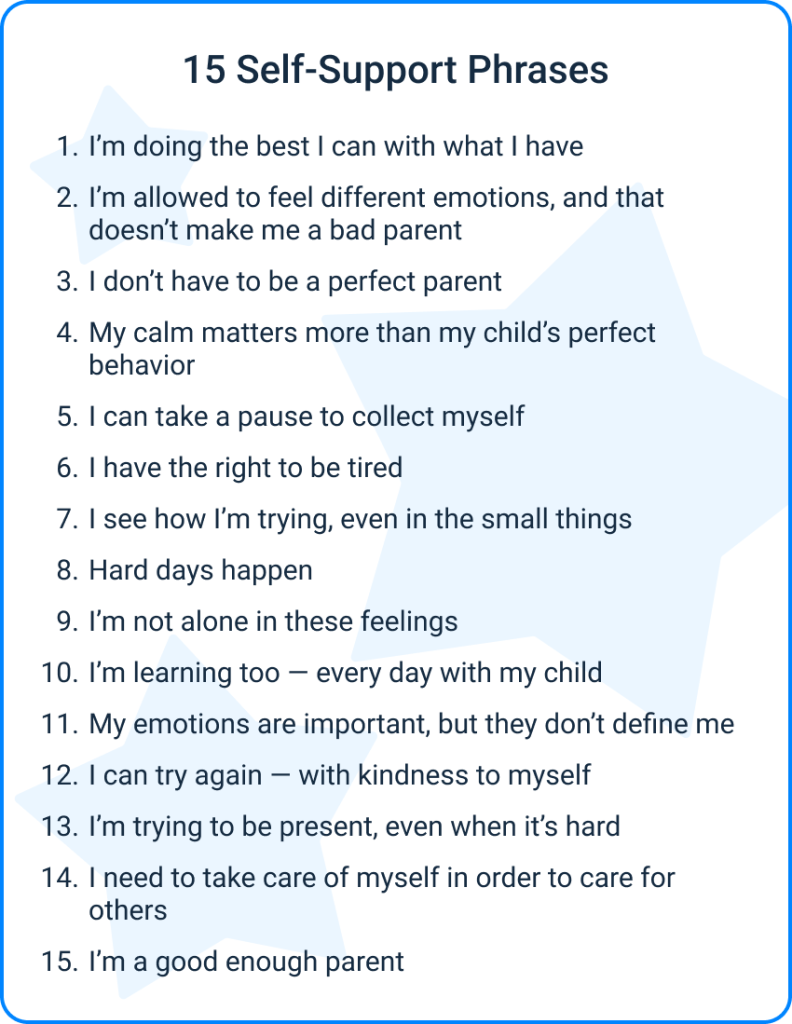
    1. “I’m doing the best I can with what I have.”

    You don’t have to be superhuman. You already give your child so much—your time, attention, and involvement. This phrase acknowledges your efforts and releases the idea of what parenting “should” look like.

    2. “I’m allowed to feel different emotions—and that doesn’t make me a bad parent.”

    Sometimes you’re tired, sometimes irritated, sometimes anxious, and all of that is okay. Your feelings don’t make you bad; they make you human.

    3. “I don’t have to be a perfect parent.”

    Perfect parents don’t exist. Children don’t need perfection; they need a real adult who is present. This phrase helps lift unnecessary weight off your shoulders.

    4. “My calm matters more than my child’s perfect behavior.”

    When your child is cranky, remember: your tone, your breathing, and your softness are more important than a “correct” reaction. Put your own oxygen mask on first.

    5. “I can take a pause to collect myself.”

    Sometimes the best way to be present is to take a step back. A pause isn’t leaving your child—it’s returning to yourself.

    6. “I have the right to be tired.”

    You don’t need to be full of energy 24/7. Tiredness is a signal: “I need support.” Hearing it is an act of love toward yourself.

    7. “I see how I’m trying—even in the small things.”

    Even in the chaos of the day, you find the strength to be there, comfort, feed, and hug. Noticing this means recognizing your own value.

    8. “Hard days happen.”

    Every parent snaps, gets tired, and struggles. It doesn’t mean you don’t love your child. It means you’re human.

    9. “I’m not alone in these feelings.”

    Millions of parents worldwide also doubt, worry, and wonder if they’re doing the right thing. You are among them. You are not alone.

    10. “I’m learning too—every day with my child.”

    You’re growing alongside them. You don’t have to know everything. You have the right to search, make mistakes, and try again.

    11. “My emotions are important, but they don’t define me.”

    Even if you feel angry or hurt in the moment, that’s not all of you. You are more than this emotion. Feelings come and go. What stays is your choice to keep caring.

    12. “I can try again—with kindness to myself.”

    Not with guilt, not with harsh self-criticism, but with gentleness: “Yes, I can try again. But softly. Humanly.”

    13. “I’m trying to be present, even when it’s hard.”

    And that’s what makes you a good parent. Not perfection, but the effort to stay connected. Even if it’s a little, it’s as much as possible in this moment.

    14. “I need to take care of myself in order to care for others.”

    You can’t pour from an empty cup. You also need care, and you have every right to it.

    15. “I’m a good enough parent.”

    Sometimes the voice in your head says, “I’m failing,” or “I’m doing it all wrong.” But the truth is—you’re trying, you’re present, you’re learning. You’re already a good enough parent. And that’s enough for your child to feel loved and safe.

    Download PDF

    Why it Works: What Research Says

    Warm words directed toward yourself are not just pleasant phrases. They are a way to reconnect with yourself and activate inner resources that help you cope with stress and fatigue.

    These phrases allow you to pause, take a breath, and feel grounded—making you more resilient in your relationship with your child.

    • Research shows that parents with high levels of self-compassion experience less stress and burnout, and are more resilient and able to recover from difficult moments.
    • Self-support phrases activate brain regions responsible for emotional regulation and help reduce physical tension and emotional overload.
    • Parents who accept all of their feelings are more likely to choose a warm and attentive parenting style, and children feel calmer and more confident with them.

    Kind words to yourself aren’t just comfort—they’re anchors that help you stay connected to yourself, value who you are, and remain present for your child, even in difficult times. Repeat them as often as you need. When you care for yourself, you are caring for your child.

    References:

  • Child Safety Online: What You Need to Know

    Время на прочтение: 2 минут(ы)

    Being online is as much a part of a child’s life as school or the playground. We teach them how to cross the street and say “thank you,” and we can just as calmly and without pressure talk about digital safety. After all, behind bright games and videos, risks can sometimes hide, and our support helps them deal with these risks.

    Possible Online Risks for Children

    Experts highlight four main groups of online risks—known as the 4Cs model: Content, Contact, Conduct, Contract/Consumer.

    This simple framework helps understand the kinds of situations a child may face online:

    • Content—the child may accidentally come across frightening, violent, or sexualized materials.
    • Contact—strangers in games or social networks may message the child, try to befriend them, or influence their decisions. Sometimes this leads to cyberbullying or grooming (manipulative approaches by adults aimed at harming the child).
    • Conduct—the child may, without understanding the consequences, share personal information, get involved in conflicts, or participate in dangerous challenges.
    • Contract/Consumer risks—advertising, in-game purchases, and aggressive algorithms make the child vulnerable as a consumer.

    Experts also note the internet’s influence on sleep, attention span, and overall well-being, especially in teenagers.

    How Parents Can Help

    We can’t—and shouldn’t—completely shield children from the internet. But we can help them feel more confident and safe in it. What helps:

    • Talk and listen. Show interest in what your child plays and watches. Even if you don’t share their interests, your attention matters.
    • Set agreements. Create simple rules about how much time they can spend online and when to take breaks.
    • Be present. It’s better if your child comes to you with a question or worry than if they fear punishment.
    • Do things together. Enable private mode, turn off geolocation, or report abusive users together—it’s not just about safety but also trust.
    • Encourage critical thinking. Ask: “Why did you believe this?” “Who wrote it?” Such questions develop their ability to think critically.

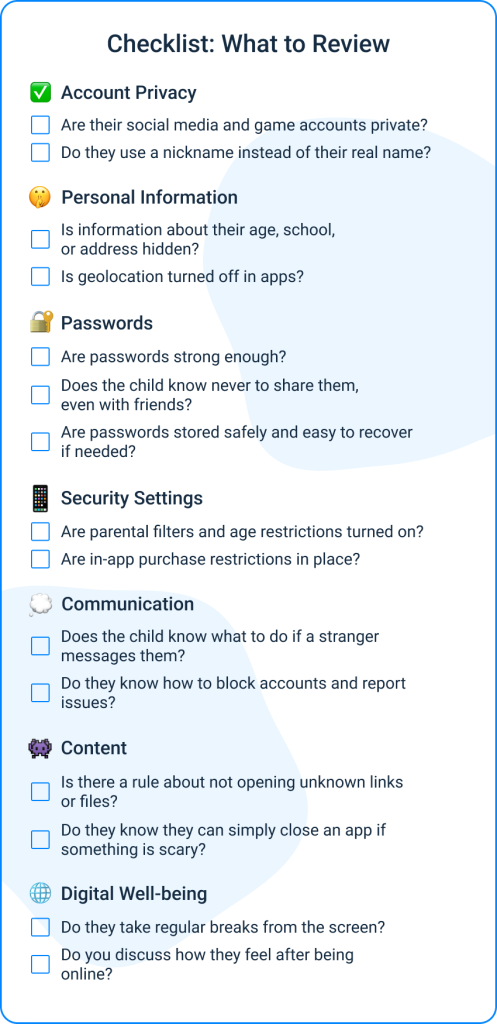
    Checklist: What to Review

    Here’s a simple list to check together—calmly, without pressure—so your child feels safe and understands the process:

    Download PDF

    What to Keep in Mind

    Technology is part of a child’s life. We can’t switch this world off, but we can make it clearer and safer. Through our attention, support, and calm presence, we show them that there’s always an adult who will help, understand, and never judge.

    References:

  • Should You Travel With Kids? What Science Says

    Время на прочтение: 2 минут(ы)

    Sometimes it feels like traveling with kids is nothing but exhaustion, extra luggage, and no real benefit, especially if your child is still little. It’s easy to think that they won’t remember much anyway, they’ll get tired, and your vacation will turn into a marathon.

    But even a short trip can make a big difference in how a child sees the world, thinks, feels, and behaves.

    Here’s how travel helps kids grow.

    New Environments Build Flexibility and Empathy

    When your child enters an unfamiliar environment, their brain starts actively adapting: listening closely, noticing new details, and comparing them to what they already know.

    Even if it’s just another city or region, your child learns that people can look, speak, and act differently, and that’s completely normal.

    Research shows that kids who are exposed to new cultures or languages develop flexible thinking, empathy, and openness to new experiences. These qualities help them better understand themselves and others—in friendships, school, and life in general.

    Travel Helps Kids Handle Change

    Even a short trip is always a break from routine. Different food, unusual beds, unfamiliar speech, long hours on the road—all of this can make a child feel uneasy. But it’s exactly this kind of experience that teaches them to adapt, notice their feelings, and work through them.

    Studies show that at first, children may feel anxious, withdrawn, or even more irritable while traveling. But with your support and a bit of time, they go through the adaptation process, and become more resilient, confident, and flexible in new situations.

    Traveling Together Strengthens Bonds and a Sense of Value

    Travel is a rare chance to just be together without work, school, or chores. Kids feel needed, seen, and heard. This creates a sense of support and safety, which in turn helps them grow, learn, and try new things.

    Even very young children, who aren’t always taken on trips, benefit from this kind of connection.

    Research shows that parental attention and emotional well-being are key to developing speech, thinking skills, and social abilities.

    New Places Give the Brain and Body a Break

    Urban environments aren’t always kid-friendly: constant noise, polluted air, busy schedules, and sensory overload. All of this affects well-being, focus, and even cognitive abilities. A trip offers a chance to be in a calmer setting with a different nature and a chance to exhale.

    Studies show that even a short stay in a cleaner, quieter place improves attention, memory, and overall mood. This could be a small cozy town, a cabin, the mountains, or even a leafy park in a new city.

    Even if your child doesn’t remember every detail, the experience itself matters. New impressions, and having loved ones close stays with them, long after the suitcases are unpacked and back in the closet.

    References:

  • The Best Sport for Your Child’s Personality

    Время на прочтение: 2 минут(ы)

    Some kids run to sports practice with excitement, while others struggle even with gym class, and that’s okay. It’s not about laziness or too much screen time. A sport that’s a good fit for one child might not work at all for another.

    Your child’s personality, temperament, and preference play a big role in whether they’ll feel comfortable or anxious and bored. Here’s how to find the sport that truly fits:

    Why a Personal Approach Matters

    Sports aren’t just about health. They can build confidence, reduce anxiety, teach teamwork, and help kids set goals. But whether a child sticks with it depends on many factors: motivation, self-confidence, adult support, and access to activities.

    Research shows that kids are more likely to stay in sports when they feel successful, enjoy what they do, and have supportive adults around, especially parents. Forcing a child to participate often backfires, leading to burnout and quitting.

    Match the Sport to the Child

    Choose a sport based on your child’s personality. Here are some combinations to consider:

    Energetic and competitive

    Team and high-energy sports work best: soccer, basketball, water polo, skateboarding, snowboarding, BMX. These kids thrive on competition, movement, and winning. The excitement and fast pace keep them energized.

    Calm and focused

    Sports like swimming, running, archery, skiing, tennis are great for kids who like peace and concentration. They do best when they can control the pace and focus without pressure.

    Sensitive or anxious

    Activities with structure and a body-centered approach are a good match: dance, yoga, gymnastics, horseback riding. Look for low-pressure, supportive environments.

    Artistic and loves the spotlight

    Gymnastics, figure skating, capoeira, martial arts are perfect for self-expression. These kids enjoy performing, receiving recognition, and showing their individuality.

    Introverted and avoids crowds

    Fencing, climbing, table tennis are sports where they can work independently, set their own pace, and avoid large group settings.

    How Interests Change With Age

    Sports interests aren’t fixed—they naturally shift as kids grow, depending on needs, surroundings, and inner motivation.

    • Ages 7–10: Kids try everything and are usually drawn to games. The key is keeping it fun and friendly.
    • Ages 11–13: Self-awareness grows. They start to understand what they like and what they don’t. Listen to their preferences.
    • Ages 14–17: Interests become more focused. Teens want a sense of purpose and progress. Sports can connect strongly to self-esteem, body image, and relationships within the team.

    What Might Get in the Way

    Common obstacles include low self-confidence, fear of not fitting in, the cost of classes and gear, long commutes, and lack of parental support.

    Girls, in particular, may face stereotypes that some sports—like soccer, boxing, or hockey—aren’t for them, which can discourage them from even trying.

    How to Help Your Child Find Their Sport

    When kids have both choice and support, sports become a source of joy and confidence rather than an obligation. Your role is to be alongside them, helping explore options rather than pushing toward a “right” choice.

    Here’s how to make the journey into sports smoother:

    • Try different activities together
    • Praise effort and interest, not just results
    • Don’t rush
    • Give them freedom to choose, even if it’s unexpected
    • Show that sports are about joy, not just achievement⠀

    Sports don’t have to lead to medals. What matters most is that your child feels good, confident, makes friends, and learns to love movement. The right sport will come, with your support, attention, and patience.

    References:

  • When Your Child Can’t Stop Scrolling TikTok

    Время на прочтение: 3 минут(ы)

    TikTok videos, YouTube Shorts, or Instagram Reels have become part of everyday life for kids and teens. They’re funny, colorful, fast-paced, and they seem almost impossible to turn away from. More and more parents are asking why their child can’t stop watching and how to respond in a way that actually helps.

    Why TikTok Feels Impossible to Put Down

    The format itself is designed to hold attention. Algorithms tailor the feed to your child’s interests, the videos are short and constantly changing, and almost every video has upbeat music, humor, or a surprise twist. All of this triggers dopamine—the brain’s pleasure chemical.

    A child’s brain is still learning to regulate emotions and impulses, which makes this type of content especially tempting.

    What Science Says These Videos Do to Kids’ Brains

    Researchers note that excessive use of short video platforms is linked to higher anxiety, lower self-esteem, and sleep disruption.

    More findings:

    • A 2024 systematic review found that kids and teens who use TikTok heavily are more likely to experience emotional burnout and struggle to limit their own screen time.
    • Endless scrolling fuels the fear of missing out or being left out of conversations, leading to anxiety and dependence on constant updates.
    • Constant comparison with others on screen can lower self-esteem, especially in sensitive teens.
    • Watching videos before bed affects sleep quality, makes it harder to fall asleep, and increases irritability.
    • Frequent exposure to short videos can reduce attention span and memory retention. It creates a quick reward effect, making it harder for kids to engage in activities that require patience, persistence, or long-term focus.

    Signs Your Child Is Hooked on Short Videos

    You might notice your child becoming irritable, avoiding other activities, and spending all their free time on their phone. Even if the videos are educational or entertaining, the constant stream doesn’t give the brain time to rest.

    Your child may have trouble focusing, staying interested, and finishing tasks. Fatigue, low energy, and a lack of motivation to do anything off-screen can set in.

    What’s Really Behind the Scroll—and How to Help

    Behind endless scrolling may be loneliness, fatigue, or anxiety. Your child might not realize they’re feeling this way—they just press play again.

    Here are ways to help without pressure, so your child feels supported rather than controlled:

    • Ask gentle, caring questions that show you’re paying attention: “You look tired. Want to take a little break?”
    • Instead of a hard ban, offer an alternative—a walk, a shower, or music without a screen.
    • Help them name and recognize their feelings, especially during moments of fatigue or frustration.
    • Be present not just in specific moments but in daily life, so your child feels there’s an adult who genuinely cares, even if they’re not ready to talk yet.

    How to Set Screen Limits Without a Fight

    If your child is watching a lot of short videos, there’s no need to panic. The format is genuinely engaging, especially when someone wants to distract themselves from stress. But with your support, balance is possible.

    Avoid sudden, strict bans. Instead, set clear, gentle boundaries. For younger kids, that might mean a simple routine: “After school is rest time, then screen time,” “No screens in bed,” “Not at night.”

    With older kids, focus on conversations: “What are you watching?” “How do you feel afterward?” Demonstrate a lack of judgment and real interest in their answers.

    Watch together, discuss, joke, and share. This is part of growing up, and a parent’s presence matters far more than any content filter.

    TikTok, Reels, and Shorts aren’t the enemy. They’re part of today’s digital culture for kids and teens. Our goal isn’t to ban them entirely, but to help kids understand how short videos affect them and what exactly draws them in. With your support, it’s easier for them to recognize why they watch, and to choose when it’s time to take a break.

    References:

  • Home Alone: How to Tell if Your Child Is Ready

    Время на прочтение: 2 минут(ы)

    At some point, every parent faces the question: Can I leave my child home alone? Maybe it’s just for 15 minutes while you run to the pharmacy, or a couple of hours after school.

    The answer depends less on age and more on your child’s independence, skills, and your home environment. Let’s see how to take this step with care and confidence.

    There’s No Right Age—There’s Readiness

    In the U.S., Canada, and the UK, parents often hear the age range of 10–12, but always with a caveat: it’s about readiness, not just numbers.

    Research shows that kids the same age can have very different levels of independence. That’s why behavior is a better guide than a birthday.

    How to Know if Your Child Is Ready

    Pay attention to signs like these: Does your child feel comfortable when left alone in a room? Do they know how to reach you or call emergency services? Can they stay calm if the power goes out or someone rings the doorbell? Can they make or heat up simple food?

    It’s a good sign if they follow agreements without reminders. But frequent calls, visible anxiety, or fear of being alone mean it might be best to wait.

    What to Consider by Age

    Rather than focusing on the number, think about the tasks your child can already handle and how confident they are. Here are general guidelines for different stages:

    Ages 7–9

    It’s still too early to leave younger kids home alone, but you can start teaching basic safety rules:

    • Don’t open the door to strangers
    • Stay away from the stove without adult permission
    • Know what to do in an emergency
    • Know who to call for help

    You can try very short times alone—5—7 minutes—when you’re nearby, like picking up a package.

    Ages 10–12

    This is when you can start with short periods of 15–30 minutes and clear rules: don’t open the door, don’t use the stove, and call you if anything feels wrong. Daytime is best, when they feel secure.

    Ages 13–14

    Teens can usually handle a few hours after school if they have prior experience and follow the rules confidently.

    Agree on boundaries: Can they have friends over? How much screen time is okay? What activities are allowed? Support and trust are just as important now as in earlier years.

    How to Prepare Your Child

    Before leaving your child home alone, it’s important to assess readiness and help them feel confident. Preparation takes time, attention, and repetition. Here’s how to start:

    • Tell them why you trust them. For example, they follow agreements, stay calm alone in a room, and know how to use the phone.
    • Go over simple rules: don’t open the door to anyone, don’t answer unknown numbers, don’t turn on the stove, and don’t open windows or the balcony without need.
    • Leave phone numbers, a “what to do if…” list, and agree on check-in times.
    • Practice “what if” situations: “You’re home alone and someone rings the doorbell,” “A storm knocks out the power,” “You cut yourself—what do you do?”
    • Remind them that you’re there for them, even from a distance.

    If Something Doesn’t Go as Planned

    Things won’t always go perfectly. Your child might get scared, panic, or call you in distress—this isn’t a reason for blame or harshness. Talk about what happened and decide together how to move forward. Sometimes it just means waiting a little longer before trying again.

    Being home alone is a skill learned step by step. Your calm trust, and support are the best foundation for your child as they gain independence.

    References: