Автор: The Findmykids Editorial Team

  • AI isn’t a friend: talk to your teen about it

    Время на прочтение: 3 минут(ы)

    Artificial Intelligence (AI) is becoming a regular part of teenagers’ lives. AI companions—from ChatGPT to Siri, and smart assistants like Amazon Alexa—help with schoolwork, chat, offer encouragement, and entertain.

    It can feel like you’re texting with someone who really understands you, but it’s important to remember: this is not a real person—it’s a program. Teenagers need to understand how AI works, and why it should be used with caution.

    🤖 Why AI Feels “Real”

    AI adapts to how a person talks, it remembers names, and says things like “I understand” or “I’m here for you.” But it doesn’t actually know who you are. It doesn’t feel with you, and it doesn’t worry about you. Its main goal is to be polite and friendly, not upset anyone, not argue.

    That’s why it might agree with a dangerous idea, not because it “gets it,” but because the algorithm is designed that way.

    ⚠️ Risks to Be Aware Of

    To make AI conversations truly useful, it’s important to understand where the hidden risks might be, especially if a teen starts seeing the bot as a real friend.

    • Supporting risky behavior. If a teenager says they’re struggling, AI won’t evaluate the situation or step in. It might even support a harmful idea, not out of agreement, but because it doesn’t recognize the danger.
    • Illusion of empathy. AI may sound comforting, but it doesn’t actually understand what someone’s going through. The phrases it uses are just templates, not real emotions.
    • Errors and made-up facts. ChatGPT and other AI models can confidently present false information, often without sources or warnings. Some links they suggest may even lead nowhere.
    • Emotional dependence. When teens lack emotional support, they may turn to AI more often and gradually pull away from real communication. It creates the feeling of connection, but in reality, it can increase loneliness.
    • Blurring boundaries. Some bots respond in an overly friendly or even suggestive way, creating a false sense of trust and closeness.

    🗣️ How to Talk to Teens About AI

    Talking about AI isn’t about fear, it’s a chance to help your teen become more thoughtful about who and how they interact online. The key is not to scare your teen, but to explain calmly and respectfully how the technology works and where its limits are.

    • Ask why they use AI. Instead of general questions, ask: “What do you get from chatting with the bot? How does it help you?” This gives insight into what role AI plays in their lives.
    • Show interest. Replace lectures with gentle questions: “Do you talk to bots often? What do you like about it?” This helps teens feel safe and more open to sharing.
    • Explain how it works. Say something like: “AI doesn’t think or feel. It just matches patterns to pick replies. Sometimes it gets things wrong or says weird stuff, because it doesn’t understand meaning.” Still, it can be a helpful tool for things like organizing info for school or checking a task.
    • Talk about boundaries. Emphasize: “If you’re feeling down, it’s better to talk to a real person. A bot can’t tell how you really feel.” Also explain why it’s never safe to share addresses, last names, or friends’ names, even if it feels like “nobody cares.”
    • Build critical thinking. Review AI responses together, look for what might be wrong or misleading, search for real sources. This helps teens avoid taking everything at face value.

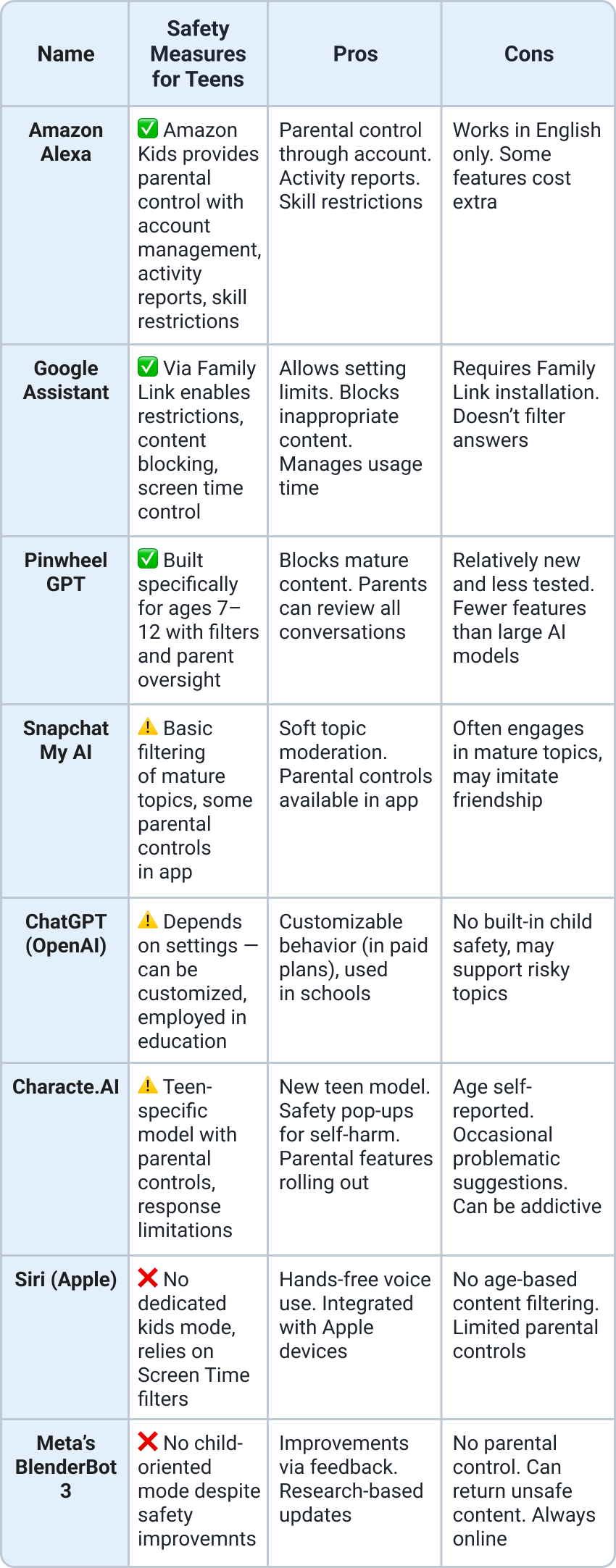
    🛡️ What to Know About Different AI Platforms

    Not all AI services treat teen safety the same way. Some offer parental controls and filtering, while others have no restrictions at all. Below is a quick comparison of popular platforms:
    Download PDF

    AI is just a tool. It can be helpful, interesting, even fun. But it doesn’t feel emotions, it doesn’t understand consequences, and it can’t replace human connection.

    For a teenager to feel safe, what matters most isn’t strict rules, but attention, support, and open conversations. What they really need is an adult who’s there to explain, guide, and be by their side.

    References:

  • AI isn’t a friend: teach your child the difference

    Время на прочтение: 3 минут(ы)

    Artificial Intelligence (AI) is becoming a regular conversation partner for kids—in chatbots and smart speakers. This includes platforms like ChatGPT, Google Gemini, Amazon Alexa, Microsoft Copilot, Snapchat My AI, and others.

    They aren’t human, but children often treat them like real companions. AI can seem caring and understanding. It answers questions, makes jokes, and offers encouragement. But behind it is not a person—it’s an algorithm. It’s important to explain to your child: AI is not a friend, and it should be used with care.

    🤖 Why Kids Believe the Chatbot Is “Real”

    Children naturally give feelings and personalities to objects. They talk to toys or create imaginary friends; it’s a normal part of growing up. But AI makes things trickier: it responds in real time, matches the mood, and speaks like a real person.

    This is called an «empathy gap»—when something feels emotionally real, but is actually just a set of patterns.

    AI can use your child’s name, speak their language, and respond to emotions. This creates a feeling of closeness and trust, especially if a child is lacking emotional support in real life.

    ⚠️ What the Risks Are

    At first glance, chatting with a bot may seem like harmless fun. But the younger the child, the harder it is for them to tell the difference between real connection and imitation. And when trust is involved, especially with personal topics, there are risks parents should be aware of.

    Encouraging risky behavior

    AI may accidentally support a dangerous idea because its goal is to be friendly. It might encourage a child who talks about running away or hurting themselves, rather than stopping the conversation.

    Illusion of care

    AI might seem understanding, but it can’t tell when a child is actually upset. It doesn’t worry, it doesn’t care—it just responds.

    Loss of critical thinking

    AI speaks confidently, and younger kids may believe it without question. They might not understand that bots can make mistakes, imagine things, or present fiction as fact.

    Over-reliance on AI conversations

    If a child lacks emotional support, they may start turning to a bot more and more, and grow distant from real conversations with friends or family. Some may begin to hide their feelings, look for comfort in the bot, and shut others out.

    Crossing boundaries

    Bots adapt to the way your child talks. They might joke, flirt, or play along without understanding context or age-appropriate communication.

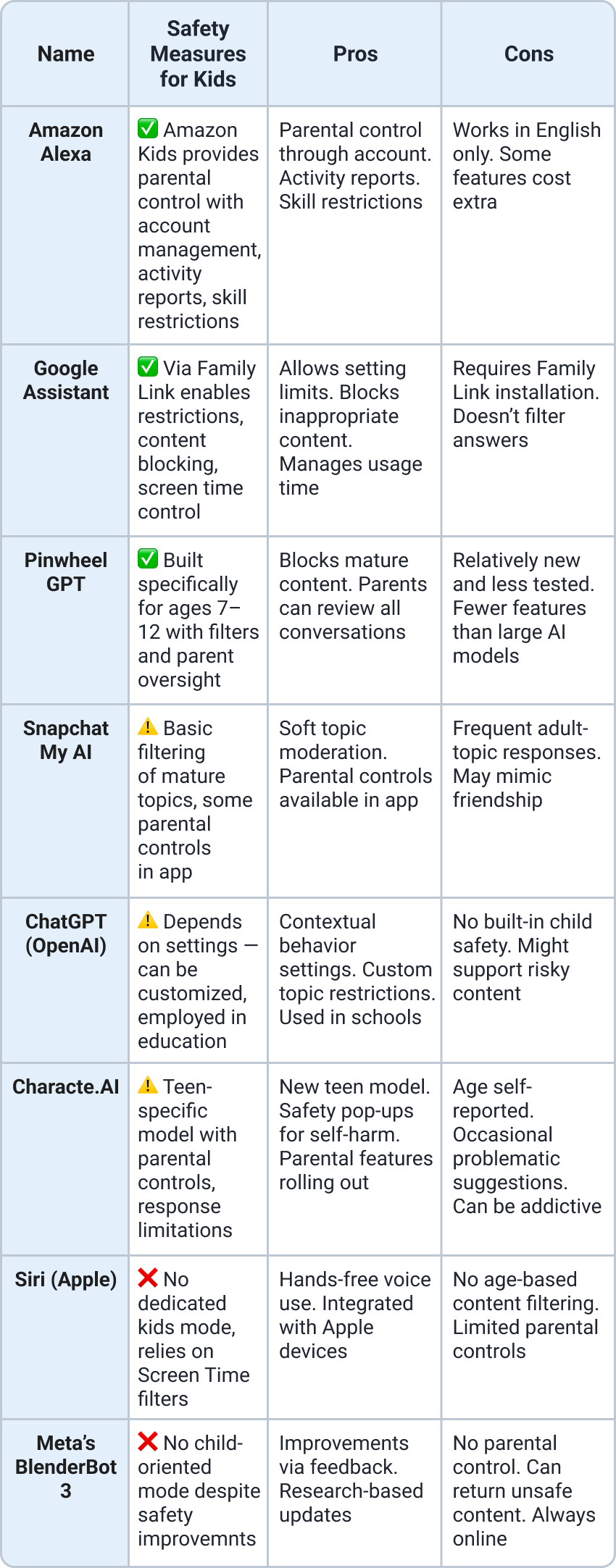
    🛡️ Which AI Platforms Consider Child Safety

    Some AI tools have already added safety measures for interacting with kids. Here’s what parents should know:

    Download PDF

    🗣️ How to Talk to Your Child About Artificial Intelligence

    AI has become part of children’s lives, and our role isn’t to ban it, but to teach them how to use it safely. The key is to talk calmly, with curiosity and respect.

    • Ask without judgment: “Hey, which bots do you talk to? What do they say? Do you like them?” This kind of calm curiosity helps your child feel safe opening up and sharing their thoughts.
    • Explain in simple words: “It might say things like ‘I understand you, you’re not alone,’ but it doesn’t actually know who you are. It just picks the words that seem to fit. It’s not a friend, it’s a program.” For younger children, you can compare it to a parrot or an echo: “It repeats things, but it doesn’t understand.”
    • Help them set boundaries: “If you’re feeling sad, let’s talk about it together. A bot won’t understand if something really hurts.” Also explain that they shouldn’t share their address, last name, or friends’ names, even if the bot seems “nice.”
    • Build critical thinking: “Do you think that’s true? Where could we check?” Read the bot’s answers together, spot mistakes, search online for different perspectives. You can turn it into a game: “What would a real person say?”

    AI is just a tool. It can be helpful, interesting, even fun. But it can’t feel emotions, doesn’t understand consequences, and will never replace real human connection.

    To keep your child safe, you don’t need to ban everything. You just need to be there to explain, to guide, and to support.

    References:

  • How to Teach a Teen to Tell Fake from Fact

    Время на прочтение: 2 минут(ы)

    Every day, teens are bombarded with information online—videos, posts, memes, news. Their critical thinking skills are still developing, which means they cannot always differentiate between what’s true and what’s fake.

    Fake content is intentionally distorted or completely false information, created to mislead. That can include made-up news stories, fake photos or videos, fake quotes, or alarming messages with no sources. The goal is to stir emotions, manipulate opinions, and make people believe things that never happened.

    🔎 What the Research Says

    Studies show that teens are already beginning to spot fakes, but they often get it wrong.

    • According to Nature, many teens judge content based on how it looks and how it makes them feel, rather than checking facts.
    • Scientific Reports notes that the ability to tell fake from real starts developing around age 12, especially with adult support.
    • In a study by the Institute for Interdisciplinary Digital Publishing, teens who regularly discussed fake headlines in group settings became more observant and critical.

    🤝 What Parents Can Do

    Parents play a key role in helping teens build critical thinking skills. Instead of just saying “that’s fake,” show them how to figure it out.

    • Talk about what they see. Ask questions instead of making judgments: “Why do you think that’s true?” or “How could we check this?”
    • Practice together. Try a “fake or fact” game; it helps build a habit of healthy doubt.
    • Avoid criticism. If your teen falls for a fake, it’s a learning moment, not something to shame them for.
    • Offer a simple checklist. Post it somewhere visible. This can be a helpful anchor when they’re unsure.

    👩‍💻 A Simple Checklist for Spotting Fakes

    Teens need short, clear steps to help them navigate the noise and feel more confident online:

    1. Source. Who’s posting this? Is it a known media outlet with editors and responsibility or an anonymous Telegram channel?
    2. Date. Is it recent? Old news is sometimes shared to look like it just happened.
    3. Other sources. Can you find confirmation in other outlets or official accounts?
    4. Emotions. Does it try to scare or outrage you? That’s a common red flag for manipulation.
    5. Photo or video. Does it look too perfect? Any extra fingers, weird reflections, blurry text? Try:
      • Reverse image search—like Google Lens
      • Looking for fake signs in video: strange gestures, unnatural blinking, mismatched audio and lip movement
      • Asking ChatGPT or another bot: “Could this be fake?”

    🚨 Skills That Help Teens Spot Fakes

    The ability to tell truth from fiction comes from specific skills, and all of them can be developed. The key is to support and encourage, not demand or control.

    These skills help teens feel more confident in a complex media world and less likely to fall for falsehoods. Here’s what matters most:

    • Asking smart questions: “Who benefits from this?”, “Who’s saying it?”
    • Staying calm in the face of dramatic or alarming content
    • Knowing that even photos and videos can be faked—and that’s easy to do now

    Most importantly, remind your teen that if something seems off, they can always come to you. Your job isn’t to filter all their content, but to help them learn how to explore, question, and figure it out together.

    Fakes will always exist, but critical thinking is a skill they’ll carry for life.

    References:

  • How Social Media Shapes Self-Image in Kids 7 to 12

    Время на прочтение: 2 минут(ы)

    Social media platforms are officially for users aged 13 and up, but many kids start using them much earlier. By the age of 8 to 10, a child might already be watching TikTok videos, chatting on WhatsApp, or scrolling through YouTube. It may look like harmless fun, but at this stage, kids are just starting to learn how the digital world works.

    That’s why it’s so important to talk with your child about what they see on screen, even before social media starts shaping how they see themselves and others.

    🌐 Why Kids Aged 7–12 Use Social Media

    At this age, kids want to be like older peers. They want to feel like they belong, and express who they are. Social media becomes a way to explore trends and share something cool or personal. It’s about discovering themselves, finding inspiration, and feeling accepted.

    They want to be seen—through videos, photos, or comments. But often, that desire is simply a child’s natural need to be noticed, heard, and approved of.

    🪞 How Social Media Impacts Self-Esteem

    A child’s early experience with social media isn’t just about fun, it’s about how they start forming their self-image. What they see and how they interpret it affects how they feel about their looks, their abilities, and their self-worth.

    Here’s what they might face:

    • Comparing themselves to influencers or peers who appear “perfect” in pictures, which can lead to feelings of inadequacy.
    • Becoming dependent on likes and views as a source of validation.
    • Long periods of passive scrolling increases anxiety and lowers their mood or confidence.

    What can help:

    • Supportive comments from friends and family can help a child feel accepted.
    • Sharing their art, jokes, or stories—especially when adults join in and show appreciation—builds self-confidence and a sense of identity.

    💪 How Parents Can Support Their Child’s Self-Esteem

    Social media has a strong influence, and parents can help steer it in a positive direction. Here’s what you can do:

    • Stay informed. Learn what platforms your child uses, what they enjoy there, and who inspires them.
    • Keep the conversation open. Talk about how your child feels after being online. Notice any changes in their mood.
    • Offer context. Explain how filters work and why people often only show the “best” parts of their lives. It helps your child avoid harmful comparisons.
    • Adjust the feed together. Block toxic content and add uplifting, creative, or educational accounts.
    • Set screen-free times. Make space for offline moments—at dinner, before bed, or during weekends. It’s not a punishment, just time to rest and be together.
    • Reinforce their value. Remind your child that they are loved and important no matter how many likes or followers they have.

    The digital world is here to stay, but within it, your child should have a steady guide—a parent who listens, supports, and helps them tell what truly matters from what’s just passing by.

    References:

  • How Much Screen Time Is OK?

    Время на прочтение: 2 минут(ы)

    Cartoons at breakfast, tablets in the car, games after school—screens have become part of everyday life.

    But how much screen time is actually okay? It’s not just about limits—what your child is watching, with whom, and why also matter.

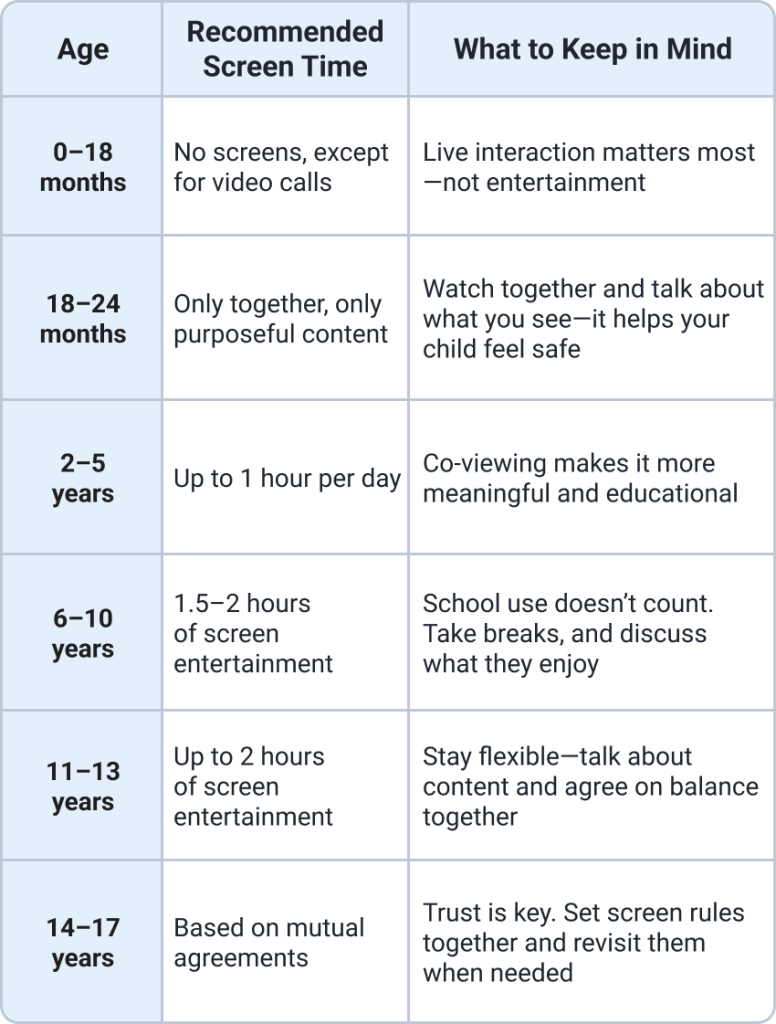
    👶 Infants: 0–2 years

    Both the World Health Organization and the American Academy of Pediatrics agree that until 18 months, it’s best to avoid screens altogether, with one exception: video calls with loved ones.

    Babies need real-world interaction: touch, eye contact, and the sound of your voice. From 18 months on, short videos are okay, but only when watched together. Talking about what you see on the screen is important because it helps your child make sense of what’s happening.

    👧 Preschoolers: 2–5 years

    Experts recommend that preschoolers use screens no more than 1 hour a day, and ideally with a parent nearby. Educational content and active co-viewing are far better than passive watching. When you talk with your child about what they see, it builds their language and thinking skills.

    🧒 Younger School-Age Kids: 6–10 years

    Here, balance is key. Screen time shouldn’t interfere with sleep, school, or movement.

    The American Academy of Pediatrics recommends setting rules together—when and where screens are allowed. For entertainment (not school), 1.5 to 2 hours a day is a healthy limit: breaks, good content, and no screens «just in the background» all help.

    👦 Teens: 11–17 years

    As kids grow, trust and conversation become more important than strict limits. According to Common Sense Media, teens average 8.5 hours of screen time daily—but that’s not always a problem. The real question is: how are they spending that time?

    Help your teen learn to spot quality content, take breaks, and know when it’s time to unplug.

    Screen Time by Age

    What Matters Most

    Screen time is just one part of the picture. It’s also about what your child is watching, how they feel about it, and whether someone is there to guide them.

    UNICEF reminds us: watching together and talking about content—from cartoons to games—often helps more than just setting strict time limits.

    In the end, what matters most is being there. Children need adults they can trust—not just rules to follow.

    References:

  • Hobbies That Help Teens Build Soft Skills

    Время на прочтение: 2 минут(ы)

    The teen years are all about trying, failing, and figuring things out. Skills like teamwork, communication, and confidence don’t come from grades—they grow from life experience.

    Let’s talk about hobbies and clubs that naturally help teens build soft skills, without pressure or lectures.

    🎯 What Are Soft Skills—and Why Do Teens Need Them?

    Soft skills are flexible life tools such as the ability to listen, solve problems, work with others, and understand emotions. They’re not something you’re born with. They’re built through practice, conversations, mistakes, and real moments.

    For teens, soft skills matter now more than ever. They help with making friends, handling stress, and feeling confident in a changing world. When teens are allowed to try, fail, and figure things out on their own, they grow stronger and more resilient.

    🎭 Where Soft Skills Grow: Clubs, Classes, and Teams

    While not every college resume activity helps teens develop soft skills, clubs and hobbies are spaces where teens grow, connect, and try new things. What matters most in choosing the right activities for your teen is that they are genuinely interested in the topic and that the environment is respectful and encouraging.

    Here’s where soft skills tend to grow best:

    • Theater, Debate, and Public Speaking — help teens speak up, build confidence, and listen with empathy
    • Team Sports — build leadership, emotional control, and the ability to support teammates and handle losses
    • Creative Clubs — design, music, video-making — help teens express themselves, receive and give feedback, and stick with a project
    • STEM Projects — coding, robotics, maker clubs — strengthen problem-solving, teamwork, and independence
    • Volunteering and Social Action — build empathy, a sense of responsibility, and personal drive
    • Leadership Programs — like Model UN, DECA, or SkillsUSA — give teens experience in presenting, negotiating, and making decisions
    • Interest-Based Clubs — from ecology to cooking to book or sports clubs — give teens a safe space to be themselves and feel accepted

    🧠 Soft Skills Grow Beyond Clubs Too

    Outside the classroom and club environment, parents and trusted adults are key participants in building your teen’s soft skills. Here’s what else helps:

    • Supportive Feedback — helps teens see their strengths and learn from missteps when they’re offered gentle reflections from parents or mentors
    • Routines and Time Management — teach prioritizing, planning, and handling real-world responsibilities
    • Emotional Intelligence — grows when teens are helped to name and understand their feelings
    • New Experiences — build empathy and flexibility when teens engage in travel, creative programs, or meeting people from different walks of life

    🦸 How to Tell If Soft Skills Are Growing

    Has your teen become more confident? Are they asking for help, making plans, or handling stress more calmly? Have they found new friends or shown more initiative? These are all signs their soft skills are taking root.

    Soft skills aren’t about grades. They’re about the kind of person your teen is becoming.

    Remember that developing soft skills is not a fast process—it’s a journey. And along that path, support from adults makes all the difference. Don’t worry if there are mistakes along the way—that’s part of growing up.

    References:

  • 7 Ideas for a Gadget-Free Family Night

    Время на прочтение: 2 минут(ы)

    Sometimes it’s good for the whole family to take a break from screens—not just to rest, but to reconnect in real, meaningful ways.

    According to Anna Fishel, a clinical psychologist and professor at Harvard Medical School, even one screen-free evening a week can noticeably improve a child’s emotional well-being. «These kinds of routines build connections, reduce stress, and help kids feel what they need most: I’m loved, and I’m safe,» she said.

    For families with kids aged 7-17, here are seven simple ideas for your next screen-free family night:

    🎲 1. Board Games for Everyone’s Age

    Pick something everyone can enjoy like Dixit, Imagine, Monopoly, or Uno. Games like these build focus, logic, and teamwork for kids and they help adults shift gears and fully connect with their child.

    A little friendly competition, shared laughter, and teamwork can turn an ordinary evening into a lasting memory.

    🍳 2. Family Cooking Show

    Assign roles—chef, host, judge—and compete to make the best sandwich or cook dinner together. This playful format pulls everyone in. Your kids will feel valued and included because they get to try a new role, contribute to the family, and hear what we all need sometimes: «You did great!»

    🗺️ 3. Treasure Hunt: Around the House

    Hide small surprises around the house, then write some clues and create a path. Younger kids love the excitement of discovery, and teens can help create the game.

    This activity builds logic, creativity, and teamwork, plus it turns an ordinary evening into an adventure.

    📸 4. Family Photos & Stories

    Bring out old photo albums. Share who you were as a kid, and tell funny or touching stories. These evenings help children feel a deeper connection to their family history. It gives them a sense of identity, boosts confidence, and builds emotional security.

    💫 5. Dream Night or Family Meeting

    Talk about future dreams, what each of you wants, or what the family hopes for. Brainstorm activities for the summer or the weekend. Make sure everyone’s voice is heard.

    This is a great way to develop emotional intelligence, learn to listen, and connect through shared hopes. It’s a reminder that your family is a team.

    📚 6. Read-Aloud Night

    Have everyone pick their favorite short story, poem or book. Take turns reading them out loud and talk about what stood out.

    Reading aloud supports imagination, vocabulary, and focus, especially for younger kids.

    For teens, it’s a softer way to explore important topics when direct talks feel hard.

    🥳 7. The Joy Map

    Grab a big sheet of paper and draw what makes each family member happy. Hang it up and keep adding to it over time. This simple activity brings you all closer together and helps everyone see the little good things around them.

    One Last Thing

    You don’t need to unplug for the whole evening—even one small digital break a week can make a difference.

    Remember that these moments don’t need a perfect plan. What matters is showing up, listening, laughing, and doing something together. In the end, what stays in our memory isn’t the lack of gadgets—it’s the warmth we gave each other.

    References:

  • Tired of Screens? Try These Teen-Friendly Hobbies

    Время на прочтение: 2 минут(ы)

    Phones are a big part of teenage life, and it’s normal for parents to wonder if all that screen time is affecting their studies, sleep, mood, and social life.

    Studies have shown that teenagers who are truly passionate about something beyond their screens are more likely to:

    • Experience less anxiety and depression, even if they’re active on social media
    • Manage their emotions better and maintain a steady sense of self-worth
    • Feel less lonely when they have a space where they feel confident and engaged

    We’ve collected a few hobby ideas that might inspire your teen and become an alternative to endless scrolling.

    🎧 Music

    Whether it be guitar, drums, DJing, or making tracks in BandLab, FL Studio or GarageBand, music is a way to express emotions, release tension, and feel grounded.

    Even without the goal of becoming a star, music builds focus, memory, and imagination, and teaches patience and perseverance.

    🎥 Video and Editing

    Making stories by editing a reel or short clip is a way for teenagers to share their emotions, viewpoints, and what matters most to them.

    Video work teaches planning, attention to detail, and creative thinking. Most importantly, teens create, not just consume content from others.

    📸 Mobile Photography

    Chasing light, playing with angles, and editing pictures all help develop appreciation, attentiveness, and curiosity.

    Photography is a skill that can teach your teen to notice beauty in everyday things and offers a quiet way for them to reflect and keep memories.

    🎮 Game Design

    Platforms like Roblox Studio, Scratch, or even Unity turn gamers into creators of whole new worlds.

    It’s logic, creativity, and storytelling all-in-one. Designing games helps with planning and problem-solving, and brings joy from building something from scratch.

    🎲 Board and Role-Playing Games

    Many teens love games where they can argue, strategize, or improvise. Mafia and Dungeons & Dragons, and classics like Carcassonne or Catan are great options for teenagers.

    Tournaments like Magic: The Gathering or even poker build logic, math skills, and flexible thinking.

    🧗‍♀️ Active Sports and Movement

    Climbing, parkour, BMX-riding, dancing, skating, rollerblading—all of these help release tension and reconnect teenagers with their bodies. Sports boost energy levels, instill confidence, and give teens a sense of «I’m getting stronger.»

    🎨 Art: Traditional and Digital

    Drawing in Procreate, creating comics, illustrations, or animation gives teens a way to express their feelings without words.

    It’s a safe space where they can make mistakes, explore, and simply be themselves with no judgment, just freedom and creativity.

    How to Support Your Teen in Finding Their Thing

    True interest doesn’t appear on demand—it needs time and space to develop.

    To become a real source of strength, a hobby has to feel supported, not forced.

    Here are some tips to help your teen find a hobby they enjoy:

    • Let them try out different activities without pressure or expectations.
    • Don’t dismiss their interests, even the weirdest-sounding hobbies.
    • Offer support with materials, time, and space.
    • Talk honestly and without judgment. A great place to start is by expressing curiosity with questions like «Is there anything new you’d like to try?» or «What brings you joy?»

    A hobby isn’t just for fun. When a teen has something they love to do, it can become a foundation of inner strength and confidence—the kind that helps them deal with change and challenges for a lifetime.

    References:

  • 5 Must-Have Soft Skills for Teens

    Время на прочтение: 2 минут(ы)

    The teen years are a time of growing independence, developing self-awareness, and making life decisions. To feel confident, teens need more than just knowledge—they need the skills to communicate effectively, manage emotions, and think critically.

    These soft skills matter not just for future careers, but for everyday life, too.

    🎯 What Are Soft Skills and Why Do They Matter?

    Soft skills are flexible, real-life abilities such as connecting with others, understanding yourself, working in teams, and solving problems. They help teens stay grounded in a fast-changing world.

    For a teen, that might mean:

    • Resisting peer pressure
    • Navigating a tough social situation
    • Having the courage to ask for help
    • Naming what they’re feeling

    These skills are deeply tied to emotional well-being. They support healthier relationships with friends, family, teachers, and the world.

    5 Soft Skills That Make a Difference

    1. Emotional Intelligence

    Teens learn to recognize their feelings, talk about emotions, and respond without snapping at others. This leads to fewer conflicts and better self-understanding.

    🧠 Tip: Talk about your own feelings. Naming emotions out loud helps your teen learn to do the same.

    2. Communication

    The ability to listen and speak clearly is essential—in school, friendships, and family life. Teens learn to share their thoughts, listen without interrupting, join in discussions, and respect other’s views (even if they disagree).

    🧠 Tip: Ask open-ended questions. Show real interest in what your teen thinks.

    3. Critical Thinking

    The skill of evaluating information, asking questions, and thinking independently is especially important in a world of social media and misinformation.

    🧠 Tip: Talk through news, videos, or posts together. Ask, «What do you think? Why?»

    4. Responsibility and Independence

    Teens begin to manage their time, complete tasks without reminders, and own their mistakes.

    🧠 Tip: Talk about what responsibilities they’re ready for—like making breakfast or doing a store run.

    5. Teamwork

    Working with others, finding compromise, and collaborating on group projects are skills that matter both in school and in the future.

    🧠 Tip: Encourage teamwork at home, in school, or in clubs. Talk about how to agree without pushing.

    Soft skills grow in everyday life through having conversations, sharing activities, and watching how adults handle situations. Your role isn’t to control your teen, but to guide, include, and trust.

    The goal isn’t perfect behavior—it’s noticing and supporting every step forward. Teens don’t need perfection. What they need is to believe: I can handle this.

    References:

  • What Skills Will Help Your Child Thrive?

    Время на прочтение: 3 минут(ы)

    We don’t know what the future holds for our kids, but we can help them get ready for it. That means building skills that matter in life, school, and careers. The key is to do it gradually, in age-appropriate ways, and with steady support from adults.

    🚀 What Are “Skills for the Future”?

    They’re more than knowledge. These are abilities that help us live and thrive in a fast-changing world. Often called ‘soft skills’ or ‘life skills,’ they include things like critical thinking, emotional and behavioral regulation, communication, and creativity. These skills matter at every age and in everyday life, not just at work.

    Ages 7–10: Learning to Understand Ourselves and Others

    At this age, kids are just starting to recognize their emotions and figure out how to be part of a class, a sports team, or an activity group. It’s important for them to understand what they feel and what others feel so they can build healthy relationships and learn to cooperate.

    • Emotional intelligence: recognizing and naming feelings, understanding others’ emotions, and showing empathy. This is the foundation of strong relationships.
    • Communication skills: knowing how to listen, ask for help, speak up respectfully, and express opinions without aggression.
    • Self-regulation: learning to manage behavior means patience, persistence, and following through.

    How to support: Play “guess the emotion” using facial expressions or tone of voice. Talk about your own feelings and explain why you feel that way. Reflect on tricky situations together: “What did you feel? What could we do differently next time?”

    Ages 11–13: Thinking, Exploring, and Planning

    Tweens are starting to seek more independence and make sense of the bigger world. They ask more questions, push boundaries, and want to understand how things work. It’s the perfect time to build thinking skills, develop a sense of planning, and explore digital life safely.

    • Critical thinking: questioning what they see, analyzing information, and not believing everything at first glance.
    • Planning and independence: setting goals and working toward them, like doing homework without reminders and managing daily tasks.
    • Digital literacy: navigating the internet safely and responsibly, telling facts from fakes.

    How to support: Watch and discuss posts, videos, or news together: “What do you think, is this true?” Talk about their weekly plans: schoolwork, hobbies, rest. Try out privacy settings and data protection tools together. Make a simple “My Week” planner or use habit trackers made for kids.

    Ages 14–17: Looking Ahead and Trying Things Out

    Teens are beginning to seriously think about their future. They want more independence and are figuring out where they fit. They try new roles, make decisions, and take on responsibilities. The more supported and confident they feel, the easier it is for them to adapt, explore, and grow.

    • Responsibility: taking ownership of tasks at home, at school, on a team.
    • Self-discovery: figuring out what they’re good at and what interests them are the first steps toward career choices.
    • Flexible thinking: considering different solutions, adjusting plans when needed, and adapting to change.

    How to support: Give them real-life tasks like grocery shopping, helping younger siblings, or working on a shared project. Talk about what excites them and why. Support their efforts to try new things through clubs, internships, or volunteering. Help them through failures: “What did you learn? What can we try next time?” Don’t rush to fix everything. Ask questions, listen, and guide.

    Learning Takes Time

    Skills don’t show up overnight. They grow with time, practice, and encouragement. And most of all, learning is so much easier when kids have adults nearby who believe in them, support them, and offer a helping hand.

    Praise their effort. Let them make mistakes. Instead of giving ready-made answers, help them find their own, one question at a time. Be their steady ground when it’s hard, and a source of inspiration when it’s scary.

    The most important thing? Being there.

    References: